
forbidden words: justice40
This is one of the terms you can’t say in the Trump Regime. See a comprehensive list at the Forbidden Words Project.
justice40
On January 27, 2021, President Joe Biden announced Executive Order (14008) titled “Tackling the Climate Crisis at Home and Abroad,” marking the climate crisis as a central point in foreign and national policy and planning. One of the programs created by EO 14008 is a government-wide Justice40 (J40) Initiative with the goal of delivering 40% of overall benefits from climate spending to disadvantaged communities. On July 20, 2021, the Chair of the Council on Environmental Quality, the National Climate Advisor, and the Director of the Office of Management and Budget issued Interim Guidance for Justice40 Implementation. The guidance was informed by recommendations from the White House Environmental Justice Advisory Council (WHEJAC) — a Presidentially-appointed council of Environmental Justice leaders and researchers from across the United States, territories, and Tribal jurisdictions.
The Biden-Harris Administration has touted the J40 initiative as “the largest-ever expansion of investments in environmental justice, toxic waste remediation, clean water infrastructure, climate change, and clean energy deployment.” (Delivering on Justice40 | the White House, 2021). J40 interim guidance lays out a timeline for agencies to develop plans to incorporate J40 goals into existing programs. The guidance revolves around providing benefits (not specific direct investments) to “disadvantaged communities.” It also includes initial metrics for defining the term “disadvantaged communities”, including support for the creation of a geo-spatial Climate and Economic Justice Screening Tool that will help identify and track metrics of community susceptibility to climate disruption and systemic bias.
This explainer video developed by The Justice40 gives a brief overview of the Justice 40 Initiative.
Justice40 is the Biden administration’s “government-wide initiative with the goal of delivering 40% of the overall benefits of relevant federal investments to disadvantaged communities and tracks performance toward that goal through the establishment of an Environmental Justice Scorecard.” We cannot assume, however, that all tactics and strategies related to the implementation of Justice40 will inherently be equitable or just.
Fortunately, we’ve identified five straight-forward questions that can guide public officials to ensure that a minimum of 40% of direct investments go to frontline communities most affected by the climate crisis. . Use the People’s Solutions Lens to determine what gets funded and whether various Justice40 proposals are rooted in justice for workers, frontline communities, and the environment:
1. Who tells the story? Frontline communities and workers are impacted first and worst by the interlinked crises of climate change and the extractive, exploitative economy. We speak for ourselves, and hold the wisdom, vision, and organizing power to lead climate and economic solutions. Yet, often times, others claim to speak for us without necessarily representing our interests. As we often say, nothing about us without us is for us.
2. Who makes the decisions? The environmental justice movement defines environment as “where we live, work, play, and pray.” Whether it’s the factory floor or the neighborhood, those closest to the problems will inevitably know the most about what the solutions need to look like. For any climate or economic solution to truly work for Indigenous Peoples, Black communities, immigrants and refugees of color, and working class communities, it must embody the practice of community self-determination.
3. Who benefits, and how? The climate crisis is ecological, but it has its roots in systemic inequity that is racial, gendered, and economic. To address these root causes, authentic climate and economic solutions must flip the existing dynamics around racial injustice, wealth extraction, and labor exploitation.
4. What else will this impact? Sometimes environmental and climate policies or “solutions” can create new problems for other issues that we care about— e.g. workers’ rights, housing, economic development, immigration, policing, mass incarceration, etc. Real solutions must work for ALL of our issues. No false solutions. No more sacrifice zones.
5. How will this build or shift power? To address the climate crisis at scale, individual and collective solutions must put us in a better position to pursue subsequent solutions. Transformative solutions, then, must do more than accomplish individualized goals, specific policies, or select projects; they must shift the landscape of political, economic, and cultural power such that subsequent goals become more attainable. Climate and economic solutions must be organizing tools that bring together a mass movement of people, workers, and communities. This is imperative to ensure the Justice40 implementation phase is both inclusive and equitable.
This tool was inspired by and adapted, with permission, from the original People’s Solutions Lens—a collaborative creation by It Takes Roots (a frontline formation composed of Climate Justice Alliance, Grassroots Global Justice Alliance, Indigenous Environmental Network, and Right to the City Alliance) and their Funder Support Circle. For more information on It Takes Roots, and to view the original People’s Solutions Lens, visit: www.ItTakesRoots.org/peoplesorientation
from — Justice40 – Climate Justice Alliance. (2022, July 25). Climate Justice Alliance. Retrieved May 2, 2026
~ ~ ~
Justice40
PEOPLE. POWER. PROSPERITY.
The Biden-Harris administration, against the backdrop of economic and climate crises, now must fulfill its campaign promise to ensure that at least 40% of federal climate investments go directly to frontline communities most affected by poverty and pollution.
We are committed to ensuring that an accountability framework centered on racial justice and equity guides these investments. Our collective collaborated on a report, authored by the UCLA Luskin Center for Innovation, that provides a clear roadmap for federal agencies to successfully and equitably design and implement Justice40. The objective of our report is to help federal decision-makers improve upon current and planned Justice40 equivalents at the state level and be inspired by community-driven investment models. We highlight state lessons, both do’s and don’ts, from which the federal government can improve upon for a transformational and accountable Justice40.
Justice40: The Need
The Justice40 promise seeks to create an equitable recovery for Americans facing challenges created by aging infrastructure, a frayed social safety net, natural disasters, and the ongoing COVID-19 pandemic. Justice40 must address inequities that hinder a sustainable, just society, and that disproportionately harm low-income and communities of color across America.
These include:
- Pollution Elevated exposure to pollution and associated health problems.
- Climate Uneven distribution of climate-related effects on the most vulnerable communities and residents.
- Funding & Capacity Unequal local government resources, community capacity, and opportunities that make it harder for those most in need to apply for green investments and limit their access to resources.
- Occupational Impacts Disproportionate access to jobs during the transition to a clean economy.
- Environmental Policy Costs & Impacts Uneven distribution of the costs and benefits of green investments and environmental programs designed to subsidize access to clean technology.
Who We Are
We are a collective of leading environmental justice movement leaders, academics, and advocates committed to working with the Biden administration to fulfill the Justice40 promise of directing 40% of climate and clean infrastructure investments to frontline communities.
Our Movement Leaders
- Cassia Herron Kentuckians For The Commonwealth
- Miya Yoshitani Asian Pacific Environmental Network
- Jacqueline Patterson The Chisholm Legacy Project
- Mark Magaña GreenLatinos
- Helen Chin Communities First
The Opportunity
Justice40 presents an unprecedented opportunity to address longstanding, critical environmental needs for America’s frontline communities. Direct investments in the communities most impacted by climate injustice will be paramount to achieving an equitable Justice40. Our collective is focused on ensuring that the federal government capitalizes on this opportunity by implementing an accountable, effective Justice40. Our recommendations include:
Develop an Accountability Framework
-
Federal agencies must develop an accountability framework, building on effective strategies and lessons learned from state efforts to invest in disadvantaged communities.
-
This should begin by establishing an investment minimum requirement (not a goal) of at least 40% (a floor, not a ceiling) for direct investments in disadvantaged communities (rather than counting trickle down benefits).
-
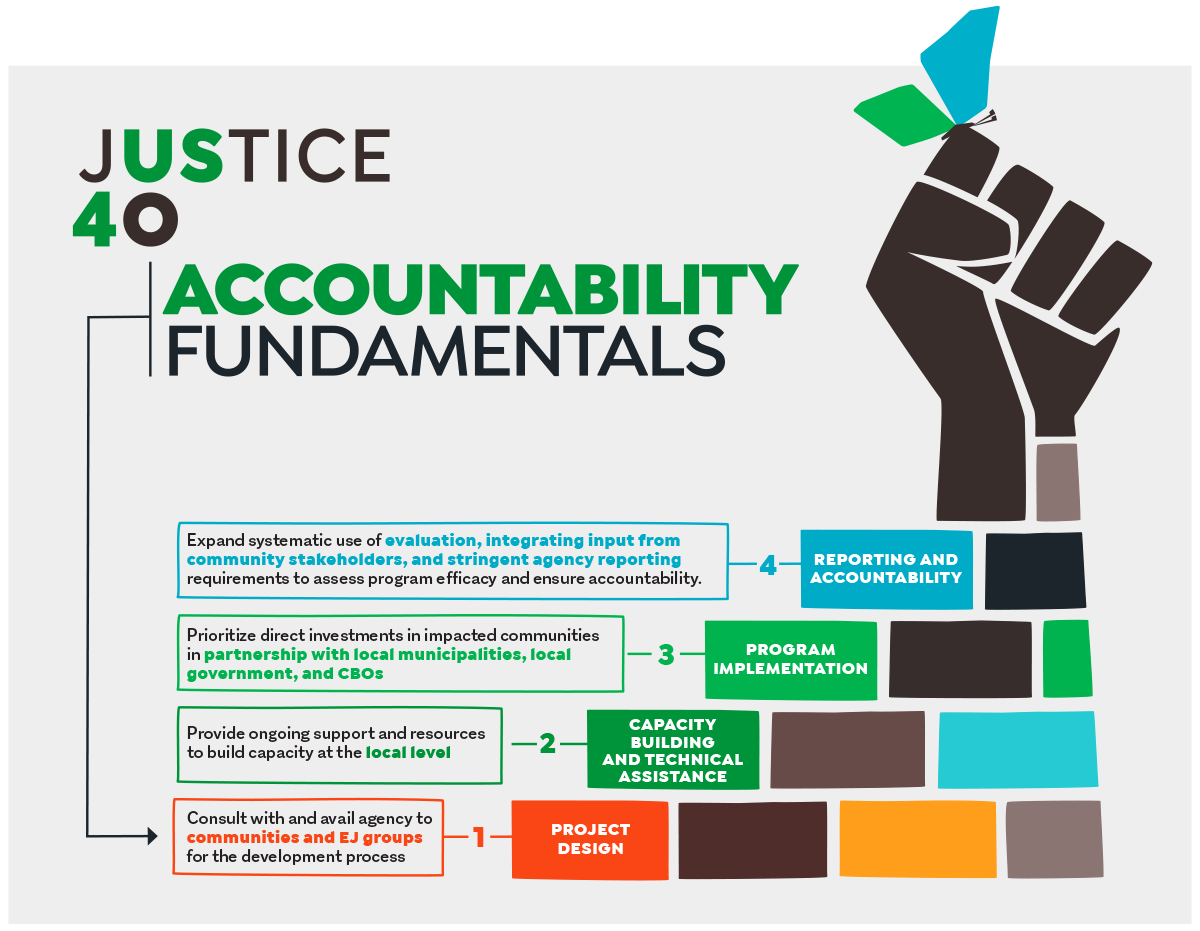
Also establish strong guardrails that include justice-oriented funding criteria, implementation requirements, transparent reporting of results, objective evaluation, robust community engagement, Congressional oversight, and enforcement mechanisms to ensure Justice40 objectives are achieved across administering agencies and states.
Local Participation and Community Empowerment
-
Justice40 must pursue a community-anchored approach that ensures frontline communities have representation and power, both in Justice40 policy-level and local investment decision-making.
-
Federal guidelines must bridge the resource and expertise gap by providing technical assistance and capacity-building support to help ensure that under-resourced communities can apply for and manage complex, resource-intensive government grants and contracts.
-
Federal agencies must directly collaborate and engage with environmental justice organizations and frontline communities to identify specific needs for programs to address.
A Holistic Approach to Justice40 Investments
-
Justice40 must maximize restorative investments in frontline communities in order to correct their long history of uneven resources and federal funding.
-
Justice40 investments must ensure that the benefits and outcomes for frontline communities are quantified and tracked over time.
-
Justice40 must embrace a holistic strategy that engages multisector programs addressing multiple disparities.
Environmental Justice:Agency Actions to Implement Past Justice40 Initiative
Fast Facts
A 2021 Executive Order directed federal agencies to address disproportionate health, environmental, economic, and climate impacts on disadvantaged communities. Federal agencies were tasked with implementing the Justice40 Initiative, which aimed to ensure that 40% of benefits from certain existing grants and programs went to these communities.
By December 2024, the Environmental Protection Agency and Departments of the Interior and Agriculture had taken numerous steps to implement the initiative. But agencies faced challenges measuring benefits to specific communities. The initiative was terminated in January 2025, and the overall results of the agencies’ actions prior to this are unknown.
Agency programs covered under the former Jusice40 Initiative provided grants and loans to support a range of activities
Highlights
What GAO Found
Executive Order (EO) 14008, issued in 2021 and revoked in January 2025, directed federal agencies to take action to address the disproportionately high and adverse human health, environmental, climate-related, and other cumulative impacts on “disadvantaged communities.” Specifically, the EO established the goal that 40 percent of the overall benefits of certain federal investments flow to such communities. Benefits could include, for example, improved health, lower home energy costs, or restored wetlands. The EO referred to this all-of-government effort as the Justice40 Initiative. The initiative did not itself create programs or provide funding. In January 2025, EO 14008 was revoked, thereby terminating the Justice40 Initiative.
As of December 2024, the Environmental Protection Agency (EPA), Department of the Interior, and U.S. Department of Agriculture (USDA) had taken actions to implement the Justice40 Initiative. These actions included integrating related goals and strategies into agency plans, taking steps to address barriers underserved communities face in accessing federal programs, issuing internal guidance, and modifying programs covered by the Justice40 Initiative. For example, in 2022 EPA issued guidance directing the 28 National Estuary Programs receiving funding through the Infrastructure Investment and Jobs Act to create a strategy describing how the funds would be used to increase benefits to disadvantaged communities, as well as how those benefits would be tracked.
The agencies also conducted outreach to Tribes, community groups, state and local governments, businesses, and the public to inform these efforts. For example, in 2022 USDA established an Equity Commission that identified barriers to inclusion or access to USDA programs. USDA then took steps to address those barriers, such as by publishing a guide to help underserved farmers, ranchers, and forest landowners better understand and access programs and resources available to them.
The three agencies also took preliminary steps to assess the results of their actions to implement the initiative. These steps included identifying data needed to evaluate barriers to and progress toward the Justice40 goal, and reporting on some programs’ funding to and impacts on underserved communities. For example, Interior reported that as of fiscal year 2024 approximately 44 percent of the more than 9,600 abandoned oil and gas wells plugged by state and local partners with funding from Interior’s Orphaned Wells Program were in disadvantaged communities.
With the termination of the initiative in January 2025, the overall results of agency actions remain unknown. According to GAO’s review of agency and Office of Management and Budget (OMB) materials, by December 2024 EPA, Interior, USDA, and OMB had not reported on what benefits resulted from each program, how those benefits were measured, or what the overall amount of funding or benefits was delivered to disadvantaged communities. Further, as of December 2024, neither the three agencies nor OMB had reported any assessments of agency actions to implement the initiative. The three agencies faced a variety of challenges identifying and measuring benefits across programs that operate at various geographic and time scales—benefits that may be difficult to attribute or quantify and may take years to manifest.
Why GAO Did This Study
Federal agencies were tasked with implementing the Justice40 Initiative for their programs—including those established by the Inflation Reduction Act of 2022 (IRA) and Infrastructure Investment and Jobs Act—that made investments in certain areas, such as clean transit and training and workforce development. By November 2023, 19 agencies had identified 518 programs that made qualifying investments, such as grants and loans, to Tribes, states, individuals, organizations, and other entities. According to the Executive Office of the President’s 2023 Environmental Justice Scorecard, Congress appropriated approximately $613 billion total for the programs for fiscal years 2022 through 2027, including supplemental appropriations such as the IRA.
TThe IRA included a provision for us to support oversight of the distribution and use of funds appropriated under the IRA and whether the economic, social, and environmental impacts of those funds are equitable. We were also asked, prior to the initiative’s termination, to review implementation of the Justice40 Initiative. This report provides information on the actions that three of the agencies with the most covered programs had taken, as of December 2024, to implement the initiative and related efforts, as well as steps they had taken to assess those actions. The three agencies GAO examined are EPA, Interior, and USDA. This report also provides information on how OMB had used the agencies’ data on Justice40 implementation as of December 2024, prior to the initiative’s termination in January 2025.
GAO reviewed documents from and interviewed officials and staff at EPA, Interior, USDA, and OMB to understand the actions each had taken as of December 2024 to implement and assess the Justice40 Initiative.
For more information, contact J. Alfredo Gómez at gomezj@gao.gov.
Trump Rescinded Biden’s Executive Order 14008 Establishing Justice40 Initiative
President Trump announced the rescission of numerous Executive Orders issued by the Biden administration, including Executive Order 14008 (Tackling the Climate Crisis at Home and Abroad). The rescission terminates the Justice40 Initiative, the EJ Scorecard, and the Climate & Economic Justice Screening Tool (CEJST), among other Biden EJ initiatives.
Executive Order 14008 also established the White House Advisory Council (WHEJAC) which the Trump Administration terminated March 1, 2025.
Background on Executive Order 14008
Under Order 14008 (the Climate Crisis Executive Order), President Biden established the Justice40 Initiative, which required agencies to direct 40 percent of the “benefits” of federal climate programs to “disadvantaged communities.” The order also required CEQ to create the Climate & Economic Justice Screening Tool (CEJST) to spatially define “disadvantaged communities” based on various climate, public health, transportation, and energy justice indicators. Covered programs included those addressing clean energy investments, transit, affordable and sustainable housing, training and workforce development, remediation and reduction of legacy pollution, and clean water infrastructure.
On March 29, 2021 The White House announced the first members of WHEJAC to provide guidance to the Administration on how to address environmental injustice.
On May 23, 2022, the White House announced it had released over $29 billion in funding consistent with Justice40, including $500 million to electrify school buses, $1.3 billion to remediate and reduce pollution, and $725 million to reclaim abandoned mine lands.
At the end of the Biden adminsitration, there were at least 518 programs covered by the Justice40 Initiative across 19 agencies. Read the list of covered programs as of November 2023.
On April 21, 2023, the Biden administration released Phase One of the Environmental Justice Scorecard, which provides a baseline assessment of agencies’ EJ-related actions in 2021 and 2022.
from — Trump rescinded Biden’s executive Order 14008 Establishing Justice40 Initiative – Environmental and Energy Law Program. (n.d.). Retrieved May 2, 2026
May 2, 2026
Salem, MA
See the complete list at the Forbidden Words Project.
image: rainbow bubble © holly troy 4.2026
Discover more from holly troy ~ sacred folly
Subscribe to get the latest posts sent to your email.
The world needs climate / justice fortyfold against / corporatist fascists