
forbidden word(s): diversity/equity efforts
diversity
diversity n 1 the state or fact of being diverse; difference; unlikeness: diversity of opinion.
Antonyms: similarity, sameness, resemblance
2 variety; multiformity.
Synonyms: multiplicity, heterogeneity, assortment, variation, dissimilarity, disagreement, contrast
Antonyms: homogeneity
3 a the spectrum of individual differences and the corresponding group memberships and identities that human beings have in society: A functioning multicultural society celebrates the diversity of its people, but diversity can also be problematic for the maintenance of a cohesive national identity.
b the inclusion of individuals representing more than one national origin, color, religion, socioeconomic stratum, sexual orientation, etc.: an initiative to increase diversity in the workplace.
4 a point of difference.
from — Dictionary.com | Meanings & Definitions of English Words. (2025i). In Dictionary.com.
~ ~ ~
equity
equity n
-
the quality of being fair or impartial; fairness; impartiality:
the equity of Solomon.
Synonyms: justice, objectivity, justness, disinterest
Antonyms: discrimination, bias, injustice, prejudice, partisanship, partiality, inequity -
something that is fair and just:
The concepts and principles of health equities and inequities are important to society as a whole. -
the policy or practice of accounting for the differences in each individual’s starting point when pursuing a goal or achievement, and working to remove barriers to equal opportunity, as by providing support based on the unique needs of individual students or employees. Compare equality ( def 1 ).
-
Law.
-
Also called chan·cer·y [chan, -s, uh, -ree, chahn, -]. the application of the dictates of conscience or the principles of natural justice to the settlement of controversies.
-
Also called chan·cer·y [chan, -s, uh, -ree, chahn, -]. a system of jurisprudence or a body of doctrines and rules developed in England and followed in the U.S., serving to supplement and remedy the limitations and the inflexibility of the common law.
-
an equitable or legally valid right or claim.
-
-
the monetary value of a property or business beyond any amounts owed on it in mortgages, claims, liens, etc.:
Over the years, they have carefully avoided tapping into their home equity for unnecessary expenses. -
Informal. ownership, especially when considered as the right to share in future profits or appreciation in value.
-
the interest of the owner of common stock in a corporation.
-
(in a margin account) the excess of the market value of the securities over any indebtedness.
-
Equity. Actors’ Equity Association.
from — Dictionary.com | Meanings & Definitions of English Words. (2025d). In Dictionary.com.
~ ~ ~
efforts
efforts, noun
-
exertion of physical or mental power.
It will take great effort to achieve victory.
-
an earnest or strenuous attempt.
an effort to keep to the schedule.
-
something done by exertion or hard work.
I thought it would be easy, but it was an effort.
-
an achievement, as in literature or art.
The painting is one of his finest efforts.
-
the amount of exertion expended for a specified purpose.
the war effort.
-
Chiefly British.
-
an organized community drive or achievement.
-
a fund-raising drive.
-
-
Mechanics. the force or energy that is applied to a machine for the accomplishment of useful work.
effort, scientific
-
Force applied against inertia.
-
The force needed by a machine in order to accomplish work on a load.
-
Compare load
effort, idioms
see all out (effort); last-ditch effort.
Related Words
Effort, application, endeavor, exertion imply actions directed or force expended toward a definite end. Effort is an expenditure of energy to accomplish some objective: He made an effort to control himself. Application is continuous effort plus careful attention: constant application to duties. Endeavor means a continued and sustained series of efforts to achieve some, often worthy and difficult, end: a constant endeavor to be useful. Exertion is the vigorous and often strenuous expenditure of energy, frequently without an end: out of breath from exertion.
Other Word Forms
- countereffort noun
- effortful adjective
- overeffort noun
- preeffort noun
Etymology
Origin of effort
First recorded in 1480–90; from Middle French, from Old French esfort, esforz, derivative of esforcier “to force” ( es- ex- 1 + forcier force )
from — Definition of effort. (n.d.).
~ ~ ~
from the National Institute for Workers Rights
Economic Dignity: Making Equal Opportunity Real: How Diversity, Equity, and Inclusion Efforts Combat Workplace Discrimination
In his inaugural address on January 20, 2025, President Donald Trump declared, “We will forge a society that is colorblind and merit-based.”[1] Subsequently, President Trump issued a series of executive orders aimed at dismantling diversity, equity, and inclusion initiatives within the federal government, major law firms, and the private sector.[2] Notably, Executive Order 14173, titled “Ending Illegal Discrimination and Restoring Merit-Based Opportunity,” rescinded longstanding affirmative action requirements for federal contractors and directed agencies to combat what it termed “illegal DEI” policies in the private sector.[3] The Equal Employment Opportunity Commission (“EEOC”) and Department of Justice (“DOJ”) later put out a “technical assistance” document indicating what the federal government views as “illegal DEI”. Though it points to a few workplace practices that could be unlawful, such as restricting employee resource group membership and separating employees by race or gender in trainings the implication is that most diversity, equity, and inclusion efforts at the workplace are perfectly legal.[4] Meanwhile, federal agencies are dismantling offices that enforce civil rights and antidiscrimination laws, thereby weakening the government’s ability to protect workers’ rights.[5]
Unfortunately, the Trump Administration’s approach will actually move us further away from a workplace that is “colorblind and merit-based.” The reason is this: women and people of color continue to face significant biases that prevent them from being judged according to their ability to work hard and do the job well. Many diversity, equity, and inclusion efforts are designed to overcome biases. Eliminating these initiatives will allow those biases to operate unchecked and expose organizations to legal risks associated with discrimination claims.
This policy brief examines the current state of workplace discrimination and demonstrates how many diversity, equity and inclusion efforts effectively address these challenges through proven strategies. Diversity, equity, and inclusion initiatives are not only consistent with the law but are often necessary to ensure compliance with it, as indicated in recent guidance from state attorneys general.[6] Indeed, many diversity, equity and inclusion initiatives emerged as measures[AF1] to address past discrimination and promote equal opportunity. The retreat from diversity, equity and inclusion from companies misses the salience of the following realities that lawyers representing workers see every day:
- Biases against women, people of color, and others at work persist.
- Diversity, equity, and inclusion initiatives counteract those biases.
- Taking away such efforts will increase discrimination and liability risk.
Biases against women, people of color, and others continue to persist
Discrimination against women and people of color remains a pervasive issue in the workplace, creating significant barriers to equal opportunity. Despite existing legal protections and social progress, women and people of color still face discrimination at every stage of their employment. There is evidence of discrimination against religious minorities, people of certain ethnic backgrounds, and LGBTQ+ individuals as well.[7] Just last year, the Equal Employment Opportunity Commission recovered nearly $700 million for over 21,000 workers with discrimination claims.[8]
Qualified Black candidates are consistently overlooked.
- At the hiring stage, white applicants receive 36% more callbacks than Black applicants and 24% more callbacks than Latino applicants, a disparity that has persisted largely unchanged for 25 years.[9]
- A study of 108 major U.S. employers found that resumes with distinctively Black names received fewer employer contacts, despite having similar qualifications, with 21% of companies showing statistically significant discrimination against Black applicants.[10]
- This finding of a penalty for Black applicants corroborates a large body of evidence which compare the success of identical resumes with Black and white names, such as the well-known “Are Emily and Greg More Employable than Lakisha and Jamal?” study.[11]
Working mothers face discrimination.
- Resumes tend to be treated more favorably if they present a male name.[12]
- Parents who take career breaks for raising children often face discrimination when re-entering the workforce, a problem particularly affecting working mothers.[13]
Women and people of color are less likely to be promoted.
In addition to the discrimination that can take place at the hiring stage, research shows that discrimination against women and people of color happens at other stages in the workplace as well.
- Women, particularly women of color, experience significant pay gaps and underrepresentation in leadership, even when controlling for other relevant factors.[14]
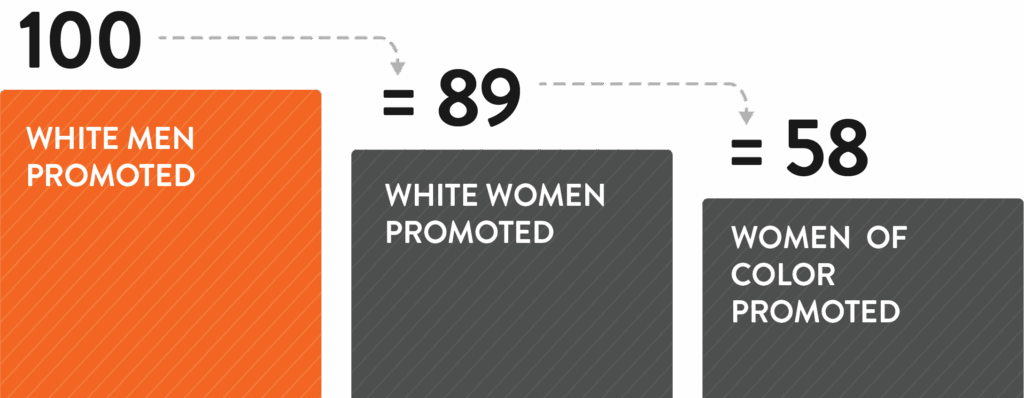
- For every 100 men promoted to manager, only 89 white women and 58 Black women are promoted.[15]
- The share of Asian Americans in the workforce also decreases with greater seniority, as does their share of promotions.[16]
- Black workers are 23% less likely to receive substantial support for advancement.[17]
Gender bias harms women on performance evaluations and promotions.
Objective qualifications cannot explain why women are underrepresented in leadership positions as research indicates that women are promoted less often than men, even when controlling for factors such as education, experience, and hours worked. [18]
- Experimental research indicates that when people hear descriptions of leadership behavior, they are more likely to rate the behavior highly if they are told the person is a man.[19] Women face penalties for displaying qualities associated with leadership, like aggression and taking charge, that are praised in men.
- Women report less access to important assignments that could help them grow professionally than men, and this is particularly so for women of color.[20]
- It is also more difficult for women of color particularly to find mentors or sponsors to help them advance and succeed.[21]
- When reviews occur, managers evaluate workers based on gendered expectations rather than purely on job performance.[22]
Diversity, Equity, and Inclusion Initiatives Counteract Known Biases.
Many diversity, equity, and inclusion programs directly address these documented patterns of discrimination through evidence-based strategies designed to ensure workplace outcomes are determined by merit and free from bias. This is not to say that all diversity, equity and inclusion efforts are effective. For example, the evidence supporting diversity or anti-bias training, particularly if delivered on a one-time basis or in isolation from regular workplace practices, is mixed at best.[23] However, research shows that many diversity, equity and inclusion initiatives increase fairness and opportunity in workplaces.
Broad, skills-based hiring counters existing bias.
In the hiring process, diversity, equity, and inclusion initiatives often expand outreach and recruitment efforts to reach qualified diverse candidates.[24] This often means dedicated staff and the involvement of human resources departments.
- Indeed, a recent study of major employers found that employers with more centralized points of contact during the hiring process were less likely to discriminate by not interviewing qualified Black candidates.[25]
- Research shows that after employers began specific efforts at broad-based recruiting, representation in management showed statistically significant increases for white women, Black men and women, Hispanic women, and Asian American men and women.[26]
- Employers with employee resource groups are even more effective at recruiting qualified candidates from diverse backgrounds, as these groups take charge of making sure recruitment happens.[27]
- Furthermore, hiring practices structured to emphasize necessary skills and qualifications, rather than subjective impressions, maximize the chances that selections are fair.[28]
Diversity officers help minimize discriminatory hiring.
- To reinforce these efforts, the appointment of diversity, equity, and inclusion officers promotes accountability for anti-discrimination practices across an organization.[29]
- Research shows that diversity managers and diversity, equity, and inclusion task forces are some of the most effective mechanisms for driving fair workplace reforms.[30]
Pay audits and structured evaluations can remedy bias.
- Regular pay audits are also essential for identifying compensation disparities, particularly those based on gender and race.[31] These audits are particularly important as discriminatory practices can compound over time through biased performance evaluations.
- Women at work are in a “double bind”: they are penalized more than men for being too aggressive, and yet also penalized for not being aggressive enough.[32]
- Organizations should implement structured evaluation systems that use clear, job-specific criteria and emphasize measurable contributions over subjective assessments.[33]
Formal mentorship programs help prevent discrimination in promotions.
- Women and people of color are at a disadvantage in getting promotions because they are less likely to be sponsored by white men in senior positions.[34]
- Research demonstrates that more formal programs lead to significant increases in the representation of Black women, as well as Latino and Asian American men and women, in management positions.[35]
- In-house management training programs and transparent nomination processes further enhance workforce diversity and increase diverse representation in leadership roles.[36]
- Additionally, tracking the distribution of high-impact projects and leadership opportunities ensures fair access to career advancement.[37]
- Furthermore, inclusion efforts encompass a wide range of practices such as providing physical accommodations like ramps, offering parental leave policies, and creating spaces for religious practices like prayer rooms. These measures both support workers and help an organization comply with equal opportunity laws.
Ceasing Diversity, Equity, and Inclusion Initiatives Will Increase Discrimination and Liability Risk.
Removing diversity, equity, and inclusion initiatives allows biases to operate unchecked, increasing the likelihood of discriminatory practices and thus the risk of legal liability. Moreover, the activities around walking back such initiatives themselves may be used as evidence against employers in discrimination litigation, as illustrated by the examples below.
Evidence of discriminatory intent or causation.
Plaintiffs’ attorneys may use corporate decisions to abandon diversity, equity, and inclusion efforts as evidence of bias or discriminatory intent. Consider, for example, a case where a company ended a program to recruit from historically Black colleges and universities shortly before they declined to interview a well-qualified candidate from such a school. If that candidate were to bring a Title VII disparate treatment claim, they would have a strong claim that the decision to end the program is evidence of racial bias.
Executives questioning the value of diversity, equity, and inclusion initiatives may also signal bias, allowing a jury to infer that an employment decision was made “because of” race, gender, or another protected trait.
- A clear recent example is Meta’s CEO Mark Zuckerberg who—at a time when he was rolling back diversity, equity and inclusion initiatives—said publicly that he thought companies had become “culturally neutered” and needed more “masculine energy.”
Undermining “reasonable care” in harassment claims.
Under Title VII, employers are required to demonstrate that they exercised reasonable care to prevent and correct workplace harassment, or else face liability. The case law underscores that the overall work environment is crucial; a retreat from diversity, equity, and inclusion initiatives can signal a decline in workplace culture, much like how the court found the employer’s superficial anti-harassment policy in Faragher inadequate despite having a policy.[38]
- Eliminating employee resource groups that provide critical support and information to people who may be reluctant to complain can be evidence of a lack of reasonable care. These groups contribute significantly to workplace inclusion by fostering community-building and trust among workers.[39] Moreover, they often provide safe spaces for women and workers of color to voice concerns, fostering trusting relationships, and, when necessary, help raise awareness of harassment policies among individuals who may be hesitant to report misconduct, even when directly affected.[40]
- Some companies have stopped submitting information to public indexes to benchmark their progress on diversity, equity, and inclusion related goals. This could also be used as evidence of a lack of reasonable care.
- For example, the Human Rights Campaign Foundation reviews policies designed to promote workplace equality, such as whether companies include sexual orientation and gender identity in their nondiscrimination policy. If companies stop participating and that leads to not taking certain measures to prevent discrimination and harassment, that would be important evidence for an LGBTQ+ employee to show that the employer failed to use “reasonable care” to create a safe and inclusive work environment.
Settlements often include equity and inclusion measures.
Recent settlements illustrate a critical point: if companies walk back diversity, equity, and inclusion measures, they may be compelled to reinstate or expand such initiatives as part of future settlements—but only after paying significant damages for the discrimination that takes place in the interim.
- For example, in 2023, a judge approved a $215 million settlement against Goldman Sachs in a sex discrimination case stemming from the company’s use of biased evaluation metrics. As part of the settlement, Goldman Sachs was required to revise its performance evaluation and promotion processes by measures such as requiring that managers discuss job-relevant criteria for promotion with Vice Presidents who report to them, mandating written manager feedback for all employees, and conducting an annual pay equity analysis overseen by an independent labor economist–initiatives that fall squarely underthe diversity, equity, and inclusion umbrella.[41]
- Similarly, Disney agreed to a $43.3 million settlement in 2023 to resolve gender pay discrimination claims and the equitable relief included retaining a labor economist to analyze and address pay equity.[42]
By proactively maintaining robust diversity, equity, and inclusion programs, employers can avoid the costly and disruptive process of being ordered to implement these measures under legal scrutiny.
Conclusion
From structured hiring processes and formal mentorship programs to pay audits and employe resource groups, many diversity, equity, and inclusion initiatives provide essential tools for creating fair and legally compliant workplaces. As attempts to restrict these programs increase, it is crucial to recognize that diversity, equity, and inclusion practices work to counteract biases against qualified women, people of color, and others that would otherwise prevent them from being considered on their merits. The EEOC and DOJ have recently issued guidance that implicitly acknowledges that most such efforts are perfectly lawful. So rather than abandoning these efforts, organizations should strengthen them, knowing that they are both legally sound and smart business. The path to truly merit-based workplaces includes active measures to ensure all qualified individuals have genuine opportunities to contribute and succeed.
Economic Dignity, Policy Brief, Publication
from — Niwr. (2025, December 10). Making Equal Opportunity Real: How Diversity, Equity, and Inclusion Efforts Combat workplace Discrimination. National Institute for Workers’ Rights.
March 13, 2025
Hudson Valley, New York
image: rusted weaving © Holly Troy 2025
This is one word you can’t say in the new Trump Administration. See a comprehensive list at the Forbidden Words Project.
Some of these moves seem tragically comical, like the elimination of photos from a Defense Department database of the World War II B-29 aircraft Enola Gay while erasing the recognition of the service of LGBTQ+ Americans who served in the military. But this is not just the ham-handed applications of President Trump’s executive orders. The reckless manner in which this is being done without regard to the consequences illustrates its nefarious intent.
from — Connelly, E. A. (2025, December 22). Federal Government’s Growing Banned Words List Is Chilling Act of Censorship. PEN America.
Climate Science Legal Defense Fund
see Silencing Science Tracker — silencingscience.org
Discover more from holly troy ~ sacred folly
Subscribe to get the latest posts sent to your email.
 holly troy ~ sacred folly
Diversity and / Equity means fair play for / all human beings
LikeLiked by 1 person