
forbidden words: discussion of federal policies: Combating Drugs and Crime
discussion of federal policies: Combating Drugs and Crime
from U.S. Department of State Policy Issues: Combating Drugs and Crime
2021-2025 ARCHIVED CONTENT
You are viewing ARCHIVED CONTENT released online from January 20, 2021 to January 20, 2025.
Content in this archive site is NOT UPDATED, and links may not function.
For current information, go to www.state.gov.
Policy Issues
Combating Drugs and Crime
The United States is deeply affected by crime and violence carried out by transnational criminal organizations, including drug cartels. These actions undermine our border security, inflict harm in our communities, and threaten the stability of our allies around the world. Today, the trafficking of overseas-produced illicit fentanyl, heroin, and other opioids into the United States is fueling a national epidemic with fatal consequences. The CDC reports that U.S. drug overdose deaths surpassed 72,000 in 2017, representing a worrying increase from the already high 2016 number. Trafficking of illicit methamphetamine, produced outside U.S. borders, into our country is also increasing.
The impact of other forms of transnational crime is felt, too, by individuals who are victimized as well as American businesses and financial institutions that suffer when crime disrupts legitimate commercial sectors, depriving workers of a level playing field to compete globally. The transnational criminal organizations that operate today are more fluid, more nimble, and more diverse than ever before. Effectively combating these networks requires a comprehensive, committed, and well-coordinated approach between the Department of State, other federal agencies, and our partners around the world. Our specialized programs to accomplish this address:
- Wildlife trafficking and other environmental crime
- Cybercrime and infringement on intellectual property rights
- Human smuggling and challenges to border security
- Corruption and money laundering that can facilitate other crimes
Read more about what specific bureaus are doing to support this policy issue:
Bureau of International Narcotics and Law Enforcement Affairs (INL): INL leads the Department of State’s efforts to combat transnational organized crime. Its work focuses on strengthening the capacity of foreign governments’ law enforcement and criminal justice systems, combating narcotics production and trafficking, and fighting corruption. Read more about INL
What is Trump’s Comprehensive Crime Bill and How Can Lawmakers Deliver Real Solutions for Safety Instead?
The Republican crime bill, rumored to arrive early in 2026, has its origins in President Donald Trump’s March 2025 address to Congress. In that speech, Trump said he was “asking for a new crime bill, getting tough on repeat offenders while enhancing protections for America’s police officers so they can do their jobs without fear of their lives being totally destroyed.”
In the nine months since, Trump has been incredibly active around crime and criminal justice, but no bill has appeared. He has addressed issues like protections for police and pretrial reform through executive orders (at a historic pace). But legislation remains appealing, as it is less likely to be challenged in court, can carry dedicated funding, can go beyond the scope of executive powers, and would outlast his presidency. In addition, legislation could be a boon to his party in the midterms, allowing them to accuse Democrats who vote against it as being “soft on crime.”
With his support on other national concerns dropping rapidly, Trump has returned to his strongest issue—crime. In August, he declared that “crime will be a big subject of the midterms,” rehashinghis 2018 midterm strategy. Following the federal takeover of Washington, DC, the long-rumored crime bill resurfaced. On August 11, Trump wrote on Truth Social: “Speaker Mike Johnson, and Leader John Thune, are working with me, and other Republicans, on a Comprehensive Crime Bill. It’s what our Country needs.” House Republicans were reportedly as surprised as everyone else; but in September, Semafor reported that Republicans were indeed at work on a bill.
Why do Trump and the GOP believe leaning into crime is an effective strategy?
In September, congressional Republicans introduced a set of bills that would roll back progress on criminal justice reform in Washington, DC, as a test run for a national bill. Dividingthe package into 13 separate bills, the GOP forced Democrats to take hard votes on crime, rightly anticipating that it would split the party. Of the seven bills that have so far advanced to the senate, six passed with support from House Democrats. Despite those crossover votes, the GOP strategy is still winning headlines like“Dozens of House Dems vote against crackdown on DC youth crime.”
Democrats have rarely mounted a strong, affirmative response to “tough-on-crime” politics. The notable exception was the 1994 Crime Bill, which took an “I-too-am-tough” approach. But America is no longer living in the 1990s: while voters remain worried about crime (despite historic lows), 81 percent of voters support criminal justice reform, and a majority support a comprehensive approach to safety that includes investments in community violence intervention, crisis response, and mental health and drug treatment.
Still, most Democrats continueto fear being perceived as “soft” on crime. That fear drove many Democrats to vote for the recent Washington, DC, bills and the Laken Riley Act. With the midterms looming, the rumored Trump crime bill presents a serious threat to criminal justice reform—despite being a dangerous power grab and not about public safety.
What might be in the crime bill?
The Semafor article gave the most details we’ve seen so far, suggesting that “tougher sentencing laws, cracking down on new synthetic drugs and organized crime, and restricting cashless bail could be in the mix for a bill.” But there has been little reporting since, and everything else is just conjecture.
Still, the administration has made many of its intentions clear, if not the exact mechanisms. Trump’s rhetoric and executive orders on issues like policing, the death penalty, pretrial detention, and federal troop deployment in cities provide some hints. Components of various “tough-on-crime” bills introduced by GOP congressmembers may be included. We can also look at criminal justice reform rollbacks recently passed in states like Louisiana, New Mexico, and North Carolina for likely models. Finally, Trump will likely continue to wield federal funding as both a carrot and stick—like the 1994 Crime Bill did in incentivizing new prisons, mandatory minimums, and so-called “truth in sentencing.”
Based on these factors, here are six things to expect from the Comprehensive Crime Bill:
Expectation 1: The bill may further the administration’s efforts to undo decades of evidence-based pretrial reform that delivers safety and justice.
- Trump is expected to make bail restrictions a centerpiece of his crime bill, using federal leverage to push more states toward rollbacks. Trump appears personally fixated on bail policy. He has issued twoexecutive orders on it and harps on it regularly, likely because it is misunderstood and easy to fearmonger around. Even though the Tenth Amendment dictates that Congress cannot set local bail rules (outside its limited authority over DC), Trump is nevertheless attempting to overstep these constitutional boundaries.
- Congressional Republicans are already road-testing these ideas. Representative Elise Stefanik has proposed banning “cashless bail” in Washington, DC; Senator Marsha Blackburn has sought to condition a key source of criminal justice funding (Byrne Justice Assistant Grants) on money bail; and Senator Tom Cotton has introduced the No Bail Post-Jail Act, requiring detention for anyone previously incarcerated for a violent felony who is arrested for another felony offense. Some or all of these ideas could show up in a larger bill.
- These proposals may take their cues from state laws and further incentivize states to roll back pretrial reforms. States like New Hampshire, North Carolina, and Texas all passed sweeping bail reform rollbacks this year. After Trump and the GOP blamed Democrats for the tragic murder of Iryna Zarutska, North Carolina passed HB 307 (“Iryna’s Law”), its toughest bail statute in decades. The law eliminates nonmonetary release for people facing any charge (violent or otherwise), creates a new “violent offenses” category, mandates electronic monitoring, expands court-ordered mental health evaluations and involuntary commitments, and assumes people charged with violent crimes will flee or pose danger—flipping the usual burden of proof. Despite reservations, Democratic Governor Josh Stein signed the bill into law, making clear how fearmongering around singular tragedies can force lawmakers into approving bad policy out of fear.
Expectation 2: The bill may include outdated “tough-on-crime” policies like longer sentences and more capital punishment.
- Trump’s crime bill could codify his “tough” sentencing agenda—especially around violent crime, the death penalty, and drug offenses. Trump’s allies are also eyeing broader rollbacks: reviving so-called “truth-in-sentencing” laws, restricting “second look” resentencing, and scaling back Clean Slate reforms. Recent GOP legislation already offers a blueprint: in June, Senators Chuck Grassley and Mike Crapo, along with nine GOP colleagues, introduced the Combating Violent and Dangerous Crime Act (S.1949), which would raise penalties for carjacking, expand kidnapping offenses (with a life sentence or death penalty if a victim dies), and add enhancements for marketing candy-flavored drugs to minors, among other provisions.
- Trump could broaden the number of death penalty-eligible federal offenses, incentivize states to expand death penalty eligibility, or ease access to execution drugs. These elements have all appeared in his executive orders or directives to Attorney General Pam Bondi. Since January, he has reinstated federal executions, directed prosecutors to pursue new death sentences, and encouraged pursuing state-level capital charges for the 37 people whose federal death sentences were commuted by President Joe Biden. He has urged the death penalty in cases involving drug trafficking, the murder of a law enforcement officer, and offenses committed by a noncitizen. Executions have surged nationwide, driven by Trump’s posture, a Supreme Court increasingly willing to clear procedural barriers, and increasingly aggressive states.
Expectation 3: The bill may push the limits of the law under the guise of combatting drug trafficking.
- After at least 21 deadly U.S. strikes on alleged drug-smuggling boats—military actions withlittle clear legal basis or utility—it is clear Trump is conducting a massive, unprecedented expansion of presidential power under the excuse of combatting drug trafficking. With congressional Republicans seemingly behind him, he faced little opposition until newsbroke of Defense Secretary Pete Hegseth potentially violating international law. The picture remains vague, but Congress could further entrench these powers by weakening key statutory guardrails like the War Powers Act of 1973 or the National Security Act of 1947, which includeguardrails to limit unilateral military action. Weakening these laws would strip Congress of its own oversight power—something Republicans have repeatedlyshown a willingness to cede. Any law here might also touch on the government’s ability to detain foreign nationals in these situations (as they seem to be doing).
- The administration is turning its war-like drug policy into a domestic assault. Trump already signed the harmful HALT Fentanyl Act in July, which permanently classifies all fentanyl-related substances as Schedule I drugs and imposes harsh mandatory minimums. A Trump crime bill could go further by adopting proposals like Senator John Kennedy’s Fairness in Fentanyl Sentencing Act (S.477), which would further lower the threshold amounts that trigger mandatory minimums. This might face limited resistance, as Democrats voted for HALT Fentanyl and have enacted such laws at the state level.
Expectation 4: The bill may attack and stifle freedom of speech and political expression.
- Trump has already laid the groundwork for a crackdown on dissent, furthering his ongoing attack against civil society. In September, he issued a National Security Presidential Memorandum (NSPM) directing agencies to “investigate, prosecute, and disrupt entities and individuals engaged in acts of political violence.” The memorandum explicitly targets “anti-police and ‘criminal justice’ riots.” It also assigns sweeping new operational roles to FBI-led Joint Terrorism Task Forces (JTTFs)–multi-agency units that fuse federal, state, and local law enforcement, although they have long drawn scrutiny for surveilling racial justice activists, journalists, and Muslim communities with little accountability. Crucially, the memo does not create new legal powers; it weaponizes vague, overbroad authorities, instructing JTTFs, the Treasury, and the IRS to target nonprofits, activists, and donors under the pretext of counterterrorism. Congressional Republicans are likely to build on this, recycling partisan rhetoric about “radical left violence” into legal proposals, such as crafting a federal domestic terrorism statute (previously backed by some Democrats) or empowering the Department of Justice (DOJ), Treasury, and IRS to revoke tax-exempt status or pursue nonprofits under the guise of financing “political violence.”
- Taken together, Trump’s NSPM and any congressional follow-through could create a powerful new infrastructure for policing political opponents under the banner of counterterrorism. The memo envisions a task force empowered to investigate and dismantle organizations—not for violent acts themselves, but for alleged association with dissenting ideologies such as “extremism on migration, race, and gender.” Blurring the line between violence and legitimate political advocacy makes it easier to criminalize nonprofits, grassroots organizing, and even philanthropic groups merely for their political beliefs. As a preview, Trump has already demanded the DOJ pursue the Soros family under the Racketeer Influenced and Corrupt Organizations Act (RICO), in the vein of Georgia’s failed “Cop City”prosecutions.
Expectation 5: The bill may make it even harder to hold law enforcement accountable when they break the law.
- This will likely be a main function of the bill, as indicated by Trump’s original comment about the bill and his executive order on policing. The bill could cover both police and other federal agents currently roaming U.S. cities, including U.S. Immigration and Customs Enforcement (ICE). It would likely enhance penalties for offenses committed against law enforcement.
- The bill could include many existing GOP proposals to shield law enforcement. House Republicans have proposed boosting qualified immunity and making it even harder to file lawsuits against police officers; criminalizing the publication of information about a federal law enforcement officer; and doubling “criminal penalties for assaulting, resisting, or impeding an ICE officer or employee.” Other proposals extend federal powers over the Washington, DC, Metropolitan Police Department, expand self-defense rights for law enforcement officers, and impose stiffer punishments—including the death penalty—for attacks on police. Some of these policies, like penalties for assaulting law enforcement, could make very difficult votes for Democrats.
- The bill could also find ways to go after reform-minded district attorneys. Trump has made no secret of his disdain for district attorneys like Philadelphia’s Larry Krasner, and Project 2025 laid bare plans to go against them. Such attacks would likely weaponize federal funding. Senators John Kennedy and Ted Cruz introduced a bill threatening to pull federal fundingfrom the districts of prosecutors who fail to report their case-referral rates to the attorney general.
Expectation 6: The bill may help Trump consolidate power by making it easier to deploy the National Guard under the guise of fighting crime.
- Trump’s effort to use the National Guard as a domestic police force is advancing aggressively—but courts are increasingly finding it unlawful. Under the banner of fighting “civil disturbances,” crime, and immigration, Trump has sent—or tried to send—National Guard troops into Chicago, Los Angeles, Memphis, and Washington, DC, and he has openly threatened deployments to Baltimore, New Orleans, and New York City. These increasinglyaggressive moves have triggered a wave of litigation. The furthest-along case is in Chicago, where a federal judge temporarily blocked the deployment after finding “insufficient evidence” of any rebellion. That case is currently before the Supreme Court, which could issue a temporary ruling soon.
- A federal crime bill could directly expand the president’s authority to deploy the National Guard—and limit how courts review those deployments. These legal disputes are significant because, for now, federal law imposes some limitson using the National Guard for crime control. One potential model, Representative Pat Harrigan’s GUARD Act, would let presidents federalize the National Guard for immigration enforcement even if governors refuse, and would allow National Guard units to arrest, detain, and deport immigrants.
Saying no to Trump’s bill is not enough. We need to advance a better vision of safety.
A bill that contains any number of these provisions—along with other policies we may not have anticipated—would amount to a historic attack on criminal justice reform as well as a huge power grab from the Trump administration. The criminal justice field and elected officials who care about safety cannot afford to wait. We must be prepared to defend the shared values of safety and justice, as well as the evidence-based progress we have made to advance them.
Rather than accepting the binary choice of voting for or against the Comprehensive Crime Bill, we should acknowledge the truism that sometimes the best defense is a good offense. Congressmembers who care about truly delivering safety and justice can do this by proposing an alternate safety bill that invests in communities and in the kinds of evidence-backed strategies that are delivering historic crime declines across the country by working to prevent crime, stop violence, and respond to crisis. Such an affirmative agenda should reflect what voters want—especially Black voters and other voters of color, who are most affected by crime and decades of mass incarceration—offering a robust, clear response to the crime fearmongering and dog whistles. Future work from Vera and partners will detail what such an affirmative agenda can look like. In the meantime, this analysis of the bill’s possible contents can hopefully help prepare for the coming fight.
from — What is Trump’s Comprehensive Crime Bill and How Can Lawmakers Deliver Real Solutions for Safety Instead?(2025, December 11). Vera Institute of Justice.
~ ~ ~
Trump on the Criminal Legal System
Threatening a New Era of Mass Incarceration
Intro
A second Trump administration threatens to accelerate mass incarceration, further dehumanize people in our criminal legal system, engage in a death penalty “killing spree,” and reverse many reforms gained over the last two decades.
Trump’s proposals are dangerous on two levels. First, with respect to the federal system, Trump will seek to double down on the failed policies of the past: encouraging brutal policing practices, pursuing extreme sentences, and expanding the use of the death penalty. Second, Trump’s racist and extremist rhetoric may embolden states that have previously embraced reform to return to failed crime policies, fueling mass incarceration and widening racial inequality.
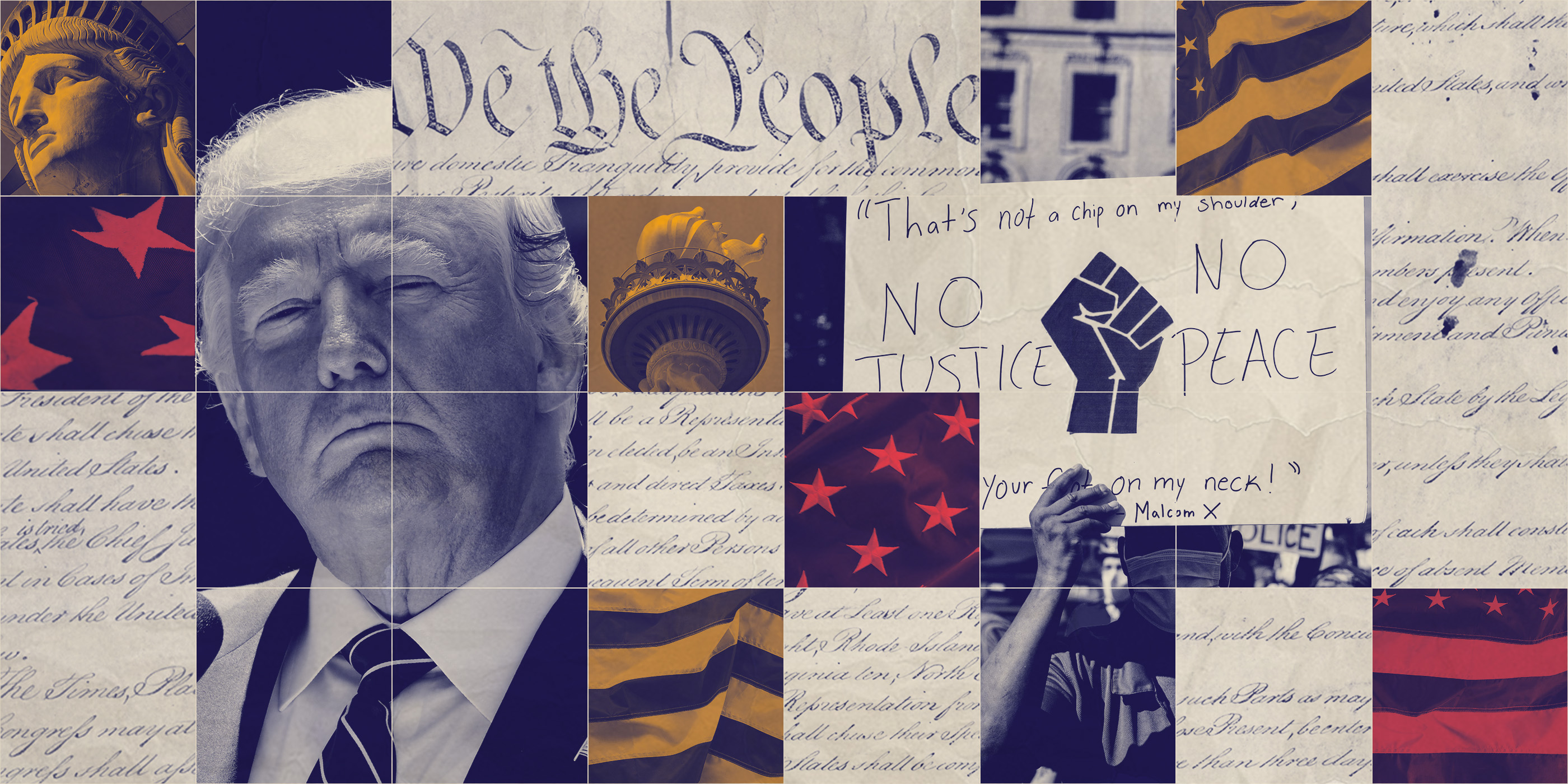
Trump Promises to Militarize Police, Reincarcerate Thousands, and Expand Death Penalty
Our analysis of a potential second Trump administration’s proposed criminal legal system policies include harmful, unlawful tactics.
Source: American Civil Liberties Union
While Trump will have a singular impact on the federal system, ultimately, many of his plans will have a trickle-down effect in states, cities, and localities. State and local governments control most of the substantive parts of state criminal legal systems, including policing, prosecution, sentencing, and conditions in prisons and jails. Today, there are over 1.6 million people in state and local jails and prisons, compared to just over 200,000 in federal jails and prisons. For this reason, much of the ACLU’s work on criminal justice is focused on the state and community level.
Even without direct control of state criminal legal systems, the president can play an important role in setting the tone for policy. According to Trump’s campaign, “There is no higher priority than quickly restoring law and order and public safety in America.” Mirroring former President Richard Nixon’s calls for “law and order” during his 1968 campaign, Trump’s tough-on-crime rhetoric can be seen as a “shorthand message promising repression of the Black Community.”
In this memo, we describe how the ACLU will oppose the specific threats that Trump poses to the federal legal system. Trump is likely to roll back hard-fought reforms to federal and state law enforcement, pursue extreme sentences, reincarcerate people currently under home confinement, exacerbate horrendous conditions in overcrowded jails and prisons, and expand the use of the death penalty. Through litigation, congressional action, and state and local advocacy, we will combat these efforts.
At the same time, we will continue to work to transform the criminal legal system and advance proven solutions. For example, we are challenging the use of law enforcement to respond to mental health emergencies in Washington County, Oregon and Washington, DC; we have put the death penalty on trial in Kansas and North Carolina; and we are challenging the Phoenix Police Department’s abuse of unhoused people. If Trump is re-elected, this critical criminal legal reform work becomes all the more urgent.
The ACLU stands at the ready to wield litigation, advocacy, and community mobilization to combat a second Trump administration’s attempts to exacerbate inequities in our criminal legal system and continue the critical work of building safe communities.
Overall Response
Courts
Litigation will play a critical role in our fight against Trump’s attempt to reinvigorate the politics of mass incarceration.
We will use the courts to halt the Trump administration’s likely attempt to carry out one of the largest — if not the largest — carceral events in our nation’s history: the senseless return to prison of nearly 3,000 individuals released on federal home confinement during the pandemic. Doing so would violate both Congress’s clear purpose in authorizing those releases under the CARES Act, and the fundamental constitutional right to due process before being deprived of liberty.
We will also meet any efforts by Trump to expand the use of the federal death penalty. In the last six months of his presidency, Trump’s administration carried out an unprecedented killing spree in which 13 federal prisoners were executed, despite troubling evidence of the torturous methods of execution used and important constitutional defenses raised by those prisoners. In light of this evidence, Attorney General Merrick Garland ordered a halt to any future federal executions and a review of the rushed policies and procedures adopted during the Trump administration. If Trump is re-elected, the ACLU will be ready to challenge the constitutional and statutory violations of another proposed execution onslaught.
If Trump’s administration adopts a new federal execution protocol, we will use public record laws and, if necessary, the courts to secure information about the protocol. We will challenge any efforts to return to unconstitutional methods of execution. Through this litigation, we will continue exposing the racism and cruelty inherent in the death penalty as we continue to seek its total abolition.
Congress
We will continue to advocate for changes to the criminal legal system in Congress and oppose any federal legislation that threatens civil liberties under any administration, including a second Trump administration. We will continue to advocate for federal agencies to invest in public safety measures during the annual appropriations process. And we will increase federal advocacy efforts to constrain the practice of providing military equipment to local police.
If past is prologue, fighting against the potential for rapidly escalating threats to the criminal legal system under a second Trump administration will require intensive coordination among members of Congress. To that end, the ACLU has expertise and readily available resources to advise and assist members of Congress on how to fully exercise their oversight rights and responsibilities. The ACLU can provide guidance for congressional hearings, congressional testimony, and engagement in and demand for oversight actions, such as sending letters to agencies to constrain authoritarian activities and requesting Government Accountability Office (GAO) reporting.
The ACLU will fight to ensure that Congress works to mitigate potential harm should Trump be re-elected.
States & Municipalities
States and localities control the bulk of the American criminal legal system. While the federal government does not have direct authority over these localized systems, Trump’s rhetoric could influence the agenda for state and local elected officials.
State governors and legislatures must increase transparency and strengthen legal checks throughout their criminal legal systems. From adopting use-of-force standards for law enforcement that prohibit the use of carotid restraints or chokeholds and no-knock warrants, to developing robust transparency standards, such as reporting deaths in custody, states must act to protect communities.
The ACLU and our affiliates will continue our work nationwide to hold state actors accountable for their actions. Under a second Trump administration, the ACLU’s commitment to ensure constitutional protections at every level of government will be stronger than ever and we will continue advocating for safeguards to be implemented immediately.
Specific Threats & Potential Responses
Law Enforcement
A second Trump administration threatens to roll back recent progress on policing and exacerbate the racial injustices of our criminal legal system. Efforts to achieve meaningful accountability for police abuse — including the killings of Black people such as George Floyd, Duante Wright, Elijah McClain, Breonna Taylor, William Green, and countless others — and to implement lasting policing reform face serious obstacles under any administration. These efforts will only become more difficult under a Trump administration given his open endorsement of authoritarian and violent policing.
In 2017, then-President Donald Trump spoke openly about his support for police abuse and violence on the part of government actors:
“When you see these thugs being thrown into the back of a paddy wagon, you just see them thrown in, rough. I said, ‘Please don’t be too nice.’…When you guys put somebody in the car and you’re protecting their head you know, the way you put their hand over [their head]? Like, ‘Don’t hit their head,’ and they’ve just killed somebody, ‘Don’t hit their head.’ I said, ‘You can take the hand away, OK?’”
Trump appointed Jeff Sessions as attorney general, the top law enforcement position within the federal government. Sessions mandated that the Department of Justice (DOJ) “pull back” on the practices of investigating police abuse and misconduct and abandon civil rights abuse litigation.
In a second Trump administration, we expect Trump will again use all the tools at his disposal to empower abusive law enforcement and discourage state and local efforts to reform policing. Trump’s rhetoric risks exacerbating police violence. For example, his calls for further protections for abusive police at the expense of community safety and his description of use of force on protesters as a “beautiful thing to watch” could embolden state actors to take a similar approach.
Beyond rhetoric, Trump will also likely exercise his executive power to overturn federal checks on local law enforcement abuse, including by immediately rescinding President Biden’s 2022 executive order on policing. Doing so would eviscerate one of the most substantial federal actions on police reform since George Floyd’s murder and roll back important changes to use of force standards, including restrictions on chokeholds and carotid restraints.
In 2017, Trump rescinded President Obama’s executive order limiting the Pentagon’s 1033 program, which allows the Department of Defense to give state, local, and federal law enforcement agencies military weapons. We expect a second Trump administration will similarly embrace increased militarization of local departments by providing local police with military equipment, tanks, and mine-resistant vehicles that have no place in local communities.
The ACLU has addressed additional threats to civil liberties through the weaponization of the criminal legal system in prior memos. In addition to encouraging the militarization of state and local police, Trump has threatened to bring the National Guard into major cities to quell violence, a clear violation of our democratic laws and norms. Enlisting law enforcement in this manner risks dangerously escalating tensions and exposing peaceful protestors to excessive or deadly force. In a second Trump administration, we will also likely see attempts to deputize local law enforcement to aid an unprecedented mass deportation effort that would decimate communities.
These expected law enforcement policies will have an outsized impact in marginalized communities. Black people are far more likely to experience police use of force and police misconduct, and three times more likely to be killed by police than white people. And, as our research shows, militarized policing is aggressively used against people of color. Trump has consistently downplayed these racialized harms of policing.
Our Response
The ACLU will use our advocacy and litigation expertise to challenge a second Trump administration’s attempts to empower, arm, and immunize police violence. We will chronicle and illuminate the injustices of a second Trump administration, as we did with the first Trump administration.
We will also continue to advocate for evidence-based solutions to public safety, and stand unwavering in our support for data-driven alternatives to incarceration should Trump be re-elected.
If Trump is re-elected, our state-level advocacy is more critical than ever, and we will work to protect communities from the police abuse encouraged by Trump. States can protect against police violence by proactively reducing opportunities for contact with police. The most common way members of the public encounter the police is via police-initiated stops, whether of drivers or pedestrians. The ACLU and our affiliates will work to end the abusive and racially biased use of traffic stops, in part by continuing to revamp traffic stop policy to deprioritize non-safety related stops to minimize overall contact with police. These non-safety related stops can escalate to violent, and even deadly encounters that disproportionately harm Black and Brown people.
Where police contact does take place, we will work to diminish its harms by continuing to push states and localities to establish use of force standards and require de-escalation training to prevent lethal encounters with police. States should ensure guardrails that provide police transparency, oversight, and accountability are in place and enforced. Wherever possible through litigation or legislative advocacy, the ACLU will also encourage robust mechanisms for civilian oversight and police accountability.
Mass Incarceration
The United States maintains the dubious title of the world’s largest known incarcerator30 in large part because of sentencing practices, like mandatory minimums, that keep far too many people in prison for far too long. On the campaign trail, Trump threatens to return to many of the ineffective and cruel policies that drove our carceral epidemic, undermining progress and fueling mass incarceration.
Below, we outline the ways in which a second Trump administration would further exacerbate our already overcrowded jail and prison system. We focus our analysis on four topics:
- Escalating punitive, draconian sentencing and incarceration approaches;
- Incentivizing dramatically worse conditions for the nation’s 1.9 million incarcerated people;
- Reincarcerating nearly 3,000 people released to federal home confinement during the pandemic; and
- Undermining recent reforms, including the First Step Act.
The ACLU is ready to challenge a second Trump administration’s efforts to further increase the size of our incarcerated population and violate the rights of those currently incarcerated.
Charging and Sentencing Practices
A second Trump administration would use federal prosecutorial power to increase mass incarceration. The policies of Trump’s first administration leaned towards a tough on crime approach. Trump’s attorney general instructed prosecutors to seek the most serious charges, increasing the likelihood of lengthy sentences and further fueling the nation’s mass incarceration crisis, especially in low-income communities and communities of color. Trump has made it clear that, with a second term, his administration will be far more aggressive in its approach to prosecution and sentencing, even usurping the authority of state and local prosecutors to use their discretion.
While Trump cannot control the charging decisions of state and local prosecutors, he will likely use his bully pulpit to pressure them to take a draconian approach. He has already declared his intention to “take on the radical Marxist prosecutors who have abolished cash bail and refuse to charge criminals” and direct the DOJ to prosecute civil-rights-minded prosecutors in major cities. The Heritage Foundation’s policy agenda for the next conservative administration calls for the “use [of] applicable federal laws to bring federal charges against criminals when local jurisdictions wrongfully allow them to evade responsibility for their conduct.”
We expect Trump’s attorney general will direct federal prosecutors to pursue the most serious possible charges and generate the longest possible sentences, broadly seeking mandatory minimums and sentences at the top of the Federal Sentencing Guidelines. Simultaneously, Trump’s administration will “support legislative effort to provide further tools” for prosecution, like the restoration of a 1984 bill that mandates severe sentences and mandatory minimums, including for non-violent crimes. This approach would likely result in excessive sentences without effectively deterring crime or improving public safety.
Trump’s plans include an aggressive revival of the severe approach to drug-crime prosecution introduced during the war-on-drugs era. Proposals from Trump and his allies include intensifying federal crackdowns on individuals at the lowest level of the drug distribution chain by “rigorously prosecut[ing] as much interstate drug activity as possible including simple possession of distributable quantities.” These measures will not make communities safer but instead exacerbate racial disparities and fail to address the root causes of the overdose crisis.
Our Response
We will combat any efforts to expand mandatory minimums or lengthen sentences. While we understand it will be a challenge given the current makeup of Congress, we will continue to fight for legislation to end sentencing disparities for crack and powder cocaine, reduce sentences for many other drug offenses — and apply these changes retroactively — and grant judges greater discretion in sentencing for lower-level drug crimes.
As we have done for decades, we will also use our research publications, communication channels, and wide supporter base to educate the public, candidates, and lawmakers on the urgent need for and impact of sentencing reform in a second Trump administration.
Since much of the American criminal legal system takes place at the state and local level, our state-level work will be more critical than ever with Trump in office. The ACLU and our affiliates will continue our state and local advocacy for sentencing reform to make our system more humane, such as by supporting policies that eliminate mandatory minimums, expand judicial discretion for low-level offenses, and reclassify and reduce sentences for drug crimes.
We will continue to advocate for clemency at the state level, urging governors to use their executive authority to provide pardons and commutations to reduce our overreliance on mass incarceration and lessen collateral consequences of convictions.
Conditions of Confinement
In addition to potentially increasing the number of people incarcerated through aggressive prosecution and harsher sentencing, a second Trump administration promises to worsen conditions for incarcerated people. Trump’s future attorney general would likely block the critical role the DOJ’s Civil Rights Division has historically played in fighting dangerous, degrading, and often lethal conditions in state prisons and local jails. The Federal Bureau of Prisons (BOP), which is part of the DOJ, would almost certainly ban abortions as well as appropriate care for incarcerated transgender people, among other marginalized communities. And we believe that a second Trump administration would overturn President Biden’s executive order phasing out the use of private, for-profit prisons and jails, just as the first Trump administration revoked a similar order issued under President Obama.
Our Response
The ACLU stands ready to defend the health, safety, and dignity of detained and incarcerated people throughout the United States. Mistreatment of prisoners based on race, sex, gender identity, or disability remains far too common. Through education, advocacy when we can, and litigation when we must, we will continue to fight for a criminal legal system in which incarceration is a last resort, rather than a first response.
The ACLU and our affiliates have been engaged in this work for decades, remaining vigilant for abuses of civil liberties across the country and defending the rights of those incarcerated. We will fight in the legislature and the courts to end the use of solitary confinement, especially for juveniles. We will fight to remove youth from adult prisons, advocate for legislative reforms to support incarcerated survivors of sexual abuse and seek proper mental health and medical care — including reproductive and gender-affirming care — for all individuals who are incarcerated. We will continue this fight across the country, regardless of attempts by the Trump administration to make an already inhumane system worse.
CARES Act Releases
Notably, under the first Trump administration, one of the most successful federal programs during the COVID-19 pandemic was the CARES Act program. Congress passed the Act in March 2020, expanding the BOP’s authority to allow people to serve the remainder of their federal sentences in the community on home confinement during the “COVID-19 emergency period.” Since then, over 13,000 people have been released to home confinement, and about 2,600 remain on home confinement. The overwhelming majority of people released under this Act successfully reintegrated into their communities without committing new offenses. Their success demonstrates that we hold far too many people in jails and prisons, and that we can significantly reduce mass incarceration, provide a second chance for incarcerated individuals, and ensure public safety.
If re-elected, Trump will likely re-imprison thousands of people living and working safely within the community on home confinement — without any legal authority. This senseless return to federal prison of nearly 3,000 individuals would be one of the largest — if not the largest — carceral events in our nation’s history.
Near the end of his term, Trump’s DOJ issued a memo concluding that the BOP “must recall prisoners in home confinement to correctional facilities…unless they would otherwise be eligible for home confinement[.]” Under the Biden administration, the DOJ announced that those released on home confinement from federal prison under the CARES Act could continue in the program subject to all the same rules and requirements of their release. A second Trump administration will form a new DOJ, and that DOJ may reverse course and require the BOP to reincarcerate all remaining individuals on home confinement under the CARES Act.
The return of nearly 3,000 individuals to federal prisons without any violation of the rules of release and without a new charge does not improve public safety. Individuals living, working, and caring for children or dependents in their communities should be given the opportunity to continue their successful rehabilitation and re-entry.
Our Response
The ACLU is prepared to challenge a second Trump administration’s attempt to reincarcerate those released under the CARES Act. We will publish a report analyzing the success of CARES Act releases and build support for the expansion of this program among key congressional members, administration officials, and the public. We will continue working with bipartisan criminal justice reform coalitions to engage elected officials and administration stakeholders on the legal and public policy imperative for allowing CARES Act home confinement recipients to remain at home.
If those efforts fail, the ACLU is prepared to file a lawsuit on behalf of all people currently on home confinement pursuant to the CARES Act, challenging any potentially unlawful decision by the Trump administration to reincarcerate individuals on home confinement.
Mass home confinement revocations are contrary to the CARES Act. Under 18 U.S.C. § 3624(c)(2), Congress intended for early placement on home confinement to last for the remainder of an individual’s sentence. Requiring people on home confinement to return to prison would destroy their progress towards reintegration, separating them from the jobs, housing, relationships, and family responsibilities they have acquired.
Mass home confinement revocations would violate the Fifth Amendment Due Process Clause. The Supreme Court has made clear that a person conditionally released from prison lives a life far different than one who remains incarcerated, and those released rely on an “implicit promise” that they will remain free as long as they comply with their conditions of release. They are therefore entitled to basic procedural protections before the government can remove them from the program.
The CARES Act is a critical measure, reducing mass incarceration by providing people an opportunity to reintegrate into their communities, and the ACLU is ready to use litigation and advocacy to challenge any attempts at mass revocation from another Trump administration.
First Step Act
In 2018, the ACLU helped secure the bipartisan First Step Act, which then-President Trump signed into law. The First Step Act was significant legislation intended to improve federal prison conditions, reform overly harsh federal sentencing provisions, and provide increased programing and re-entry transition services to people incarcerated in federal prisons.
Despite the promise of the Act, Trump’s record on the First Step Act is mixed and many of its key reforms were undermined by Trump’s own administration. The risk assessment tool known as PATTERN, which was developed as part of the Act, was flawed and racially biased, overcalculating the risk for Black, Hispanic, and Asian individuals to be released. In response to the concerns raised by the ACLU and other reform advocates, Trump’s DOJ announced purported changes to the risk assessment tool in 2020; however, the changes actually made it harder for individuals to qualify as “low risk” and be released during the COVID-19 pandemic. The Trump administration also drastically underfunded the educational and vocational programs necessary for reducing sentences, initially allocating only $14 million of the $75 million required annually for these programs, impeding peoples’ ability to reduce their sentences by completing necessary programming.
While the First Step Act did see some success — 3,100 people were released based on “good conduct time” and 2,300 received retroactive sentence reductions in its first year, — a second Trump term poses the risk of undermining these reforms.
Our Response
Under any administration, the ACLU will strive to preserve criminal justice reforms, implement legislative victories, and advocate for policies to end mass incarceration. In a second Trump term, the ACLU will advocate for full implementation of the First Step Act’s rehabilitative and re-entry programming. We will also endeavor to mobilize Trump allies — like his son-in-law Jared Kushner — to marshal support for full implementation of the Act.
The ACLU will also advocate for solutions to problems with the First Step Act’s implementation, such as the flawed risk assessment tool, PATTERN, which has been criticized for racial bias and perpetuating systemic issues, ultimately making it more difficult for people incarcerated to fully benefit from the Act. For example, as reported, it is “mathematically impossible for men under the age of 26 to qualify as ‘minimum’ risk’ — the lowest possible risk category.” Specifically, we will advocate for adjustments to the definition of “recidivism,” and to expand considerations for individuals to qualify as minimum or low risk by adjusting the relative weight of various inputs.
Given the fact that Trump advocated for and signed the First Step Act, if his second administration is open to further reforms toward the same goals, the ACLU will work with the administration and Congress to expand the First Step Act’s sentencing provisions retroactively, particularly for those affected by racially disparate drug policies. Ultimately, the First Step Act was just that — a first step towards meaningful, necessary changes to our criminal legal system, and the ACLU will push Congress to reject any threats to the progress this bill has made and build on its successes through robust and necessary funding.
Death Penalty
Buried deep in the Heritage Foundation’s “Mandate for Leadership” is a single paragraph that forewarns the future of capital punishment under a new Trump regime: He will seek to expand the categories of crimes punishable by death, sentence more people to die, and then kill every person on federal death row.
Guided by the long-debunked myth that capital punishment deters crime, and with no regard for decades of Supreme Court precedent, Trump seeks to expand the range of crimes that are punishable by death. He has reportedly called for the death penalty as punishment for treason for those who leak information against him in the press or undermine him politically. He will attempt to expand the death penalty to non-homicide crimes, such as drug sale, human trafficking, and child rape, a move the Supreme Court found to be unconstitutionally cruel and unusual punishment in Kennedy v. Louisiana, 554 U.S. 407 (2008). As the ACLU argued in our amicus brief in Kennedy, our country almost exclusively reserved its executions for non-homicide crimes for people of color, most frequently for cases with white victims. Trump’s insistence on actively pursuing death in non-homicide crimes threatens to drive extreme sentencing across the board, making every sentence less than death (falsely) seem comparatively lenient.
As for manner of execution, Trump has “privately mused” on bringing back firing squads, the guillotine, and hangings by noose — a symbol and tool of our country’s sordid legacy of lynching and racial terror.
Trump’s embrace of capital punishment is longstanding. In the 1980s, as a private citizen, he paid $85,000 from his own funds to publish a page-wide advertisement calling for the execution of five Black and Latine boys wrongfully accused as the “Central Park Five.” Even before his first presidential run, he repeatedly called for death in highprofile cases via his private Twitter account. As Trump has shown, again and again, when given the chance to use the death penalty, he will.
We know Trump’s threat is real, because it is the continuation of his unprecedented killing spree in his final six months in office. Even amid the chaos of his attempts to overturn the 2020 election and his supporters’ raid of the Capitol, Trump continued to rush executions, ultimately executing 13 people on federal death row. Trump executed two Black men for crimes they committed as teenagers. He executed a woman with mental illness who had survived a lifetime of horrific sexual abuse and torture. He executed a man with intellectual disabilities and a 67-year-old man whose Alzheimer’s disease left him unaware of the reason he was sentenced to die. Ultimately, a majority of those executed during Trump’s killing spree were people of color, including seven Black men and one Native American man. These executions put clear disregard for the Constitution on full display.
Trump was able to execute these people so swiftly because of the Supreme Court’s complicity. With its three Trump appointees, the court cast aside lower-court rulings — often in the dead of night — that called for review of critical, life-saving legal claims.
During Trump’s killing spree, the ACLU defended the rights of a medically vulnerable priest who sought, after an 11-year relationship with Wesley Purkey, to witness and minister to Mr. Purkey at his July 2020 execution, but feared COVID exposure and illness. We secured improved death watch conditions for the last days of Lisa Montgomery; after enduring a history of horrific sexual abuse, Montgomery was subjected to 24/7 monitoring by male prison guards (even when using the toilet) preceding her execution. The ACLU’s lawsuit put a stop to this demeaning practice and allowed her a measure of dignity in her final days.
Finally, taking a page from the lessons of Justice Thurgood Marshall, who famously stated that the American people only support the death penalty because they do not understand what it entails, the ACLU has previously sought to expose the federal death penalty’s fatal flaws and inherent racism. We successfully fought in court for the release of federal records revealing some of the costs of the federal executions — both dollars and human lives. The disclosures revealed the inadequacies of the federal government’s COVID-19 contact tracing and testing during executions, and how this recklessness resulted in severe illness and death. The ACLU played a central role in communicating other injustices of the execution spree, including its inherent racism, and the use of executions against people with mental illness, intellectual disabilities, and those that have endured great trauma. And we showed the continuing trauma that executions cause throughout low-income and marginalized communities.
The ACLU’s execution lawsuits and public education efforts brought immense value to the fight against unlawful executions, and we will double down on these efforts should Trump attempt to repeat these actions.
Our Response
The ACLU stands ready as ever to fight Trump’s dangerous and illegal attempt to expand the federal death penalty.
Legal Analysis & Litigation
If Trump is elected and attempts to expand the use of the death penalty, the ACLU will challenge his unconstitutional and unlawful plans in court. Many of Trump’s announced plans would flout the Eighth Amendment’s bar on cruel and unusual punishment.
Trump’s proposal to expand the application of the death penalty to non-homicide crimes like drug trafficking or child rape would be barred under nearly 50 years of settled Eighth Amendment jurisprudence. Expansion of the death penalty to non-homicide cases is just as disproportionate of a punishment today as it was in 1977 when the Supreme Court rejected it, and just as likely to result in racially discriminatory application. The ACLU will challenge any effort by Trump to bring back this unlawful punishment.
The ACLU will also ensure that any effort by Trump to carry out another execution spree is met with intense scrutiny and opposition. While the lawyers appointed to represent the condemned will focus their efforts on the legal claims specific to their individual clients, the ACLU is prepared to uncover and litigate systemic challenges to Trump’s plans.
The ACLU will challenge any future effort by Trump to bring back torturous methods of execution.91 Every federal execution since Congress authorized executions in 1988 has been carried out by lethal injection. All of the executions under Trump were carried out under a new protocol addendum adopted during his administration. This protocol called for a drug that was shown to inflict excruciatingly painful flash pulmonary edema during the federal executions. Recognizing the likelihood that these executions violated the federal government’s obligation to avoid extreme pain and suffering, Attorney General Garland ordered the federal protocol suspended and a placed moratorium on executions while the Office of Legal Policy conducted a full review.
Perhaps in recognition of the problems with lethal injection during his administration, Trump has called for the use of hanging and guillotine as alternative methods. A number of states have introduced or proposed other torturous methods such as lethal gas, the electric chair, and the firing squad. We stand ready to fight back against any unnecessarily cruel new execution methods by invoking twin lines of Eighth Amendment jurisprudence that forbid specific applications that have fallen so out of the norm that only a few jurisdictions retain them, or that involve terror, pain, or disgrace in excess of what is necessary.
Federal & State Level
Equally true of Trump’s other attempts to shred the Constitution, congressional oversight remains important with the federal death penalty. Drawing on our technical expertise, the ACLU will push for such oversight to ensure transparency in the execution process, including with respect to the lethal-injection drugs used (which frequently come from unregulated compounding pharmacies).
While Trump would have no authority over the dwindling number of states that retain the death penalty, his influence from the bully pulpit cannot be ignored. The ACLU will double down on our ongoing work against the death penalty in the states. We will continue our litigation efforts that put the death penalty “on trial” in the states by leveraging state laws that are more protective than the U.S. Constitution — like state Racial Justice Acts and constitutions — to invalidate the death penalty based on its racist administration, including in the selection of juries.
The ACLU’s legislative and other advocacy efforts to abolish the death penalty in the states will continue. In close partnership with our affiliates, we will continue our work to pass legislation abolishing the death penalty, restricting its use, and preventing efforts to either expand offenses eligible for the death penalty or permissible execution methods. Through our advocacy and litigation in recent years, multiple states have abolished the death penalty, imposed a moratorium, or condemned the punishment due to its inherent links with our nation’s history of racism and lynching. This includes states as varied as Virginia, California, Connecticut, and Washington. As the number of states willing to abandon this failed government experiment continues to grow, the movement will expose the Trump administration’s attempt to revive the federal death penalty as an immoral break from our evolving standards of decency.
Ultimately, all of these efforts aim to repeal both the federal death penalty and its imposition in every state jurisdiction.
Conclusion
While criminal legal policy is primarily a state and local issue, an undeniable lesson of the era of mass incarceration is that the federal government plays a pivotal role in setting the tone. A new Trump administration threatens to drown out millions of voices across the country demanding investments in their communities that address the root causes of crime. Trump instead promises a return to the tough-on-crime, failed politics of mass incarceration.
The ACLU will defend against Trump’s efforts to bring in a new wave of mass incarceration, including by fighting against his attempts to encourage police abuses, grow our federal prison population – going so far as to reincarcerate people in home confinement — and expand the federal death penalty. We will advocate for congressional oversight to prevent potential harms threatened by Trump. And we will take a Trump administration to court if necessary to protect our civil liberties.
While we defend the hard-won reforms from the last few years to improve the system, we will also continue our long-term fight to end the country’s carceral epidemic and advocate for our long-term vision of public safety.
For information on copyright, usage rights, and privacy, please visit the ACLU Site User Agreement at https://www.aclu.org/about/aclu-site-user-agreement.
For information on accessibility, please visit the ACLU Statement on Website Accessibility at https://www.aclu.org/about/aclu-statement-accessibility.
Download PDF
Citations and endnotes can be found in the full, downloadable PDF.
from — American Civil Liberties Union. (2024, September 20). Trump on the criminal legal system | American Civil Liberties Union.
February 20th, 2026
Saturn and Neptune conjunct 0º Aries
Hudson Valley, New York
This is one of the words/ phrases you can’t say in the new Trump Regime. See a comprehensive list at the Forbidden Words Project.
image: behind the surgery center © Holly Troy 2026
There’s nothing “free” about banning words or ideas.
from — Connelly, E. A. (2025, December 22). Federal Government’s Growing Banned Words List Is Chilling Act of Censorship. PEN America.
Climate Science Legal Defense Fund
see Silencing Science Tracker — https://silencingscience.org/
Discover more from holly troy ~ sacred folly
Subscribe to get the latest posts sent to your email.
 holly troy ~ sacred folly
Combatting crime should / begin with the President / and the Epstein Files
LikeLiked by 1 person