
forbidden words: climate accountability
climate accountability
A climate accountability framework is a set of governance structures and processes that connect long-term climate targets and pledges to near-term policy planning and implementation through regular, transparent stock-taking and progress reporting.
~ ~
American Legislative Exchange Council: Climate Accountability Act
Section 1. {Intent}
The legislature finds that in order to improve efficiency and the use of scarce resources, the state must receive the greatest return on the environmental investments it makes. Projects that do not return the expected environmental benefits waste not only the funds given to the project but also prevent funding from being available for projects that would have a positive environmental impact.
The legislature additionally finds that reliable information and accountability are critical to ensuring that environmental projects are effective. By setting clear goals, the state can determine what projects best promote environmental sustainability and allow the state to hold contractors and agencies accountable if those goals are not met.
The legislature believes that by promoting climate accountability, the state can make the most of its resources in the effort to reduce greenhouse gas emissions and promote energy efficiency.
Section 2. {Definitions}
(A) “Climate Expenditure” – Any state expenditure designed to reduce greenhouse gas emissions.
(B) “CO2e” – Carbon dioxide equivalent calculated as greenhouse gases normalized to metric tons of carbon dioxide.
(C) “Certified Carbon Offsets” – Carbon credits certified to meet the UN’s Clean Development Mechanism (CDM).
Section 3. {Assessment of Climate Priorities}
(A) Any government climate expenditure intended to reduce greenhouse gas emissions must, prior to implementation, provide the following information:
(1) Number of tons of CO2e reduced by the climate action
(2) Total cost of climate action
(3) Cost per ton of CO2e reduction
(B) Any state contracts required to implement climate expenditure must include cost per ton of CO2e reduction in the performance portion of the contract.
Section 4. {Climate Accountability}
(A) The state shall regularly audit to ensure that climate expenditure contracts are meeting performance standards for cost per ton of CO2e. If contractors are not in compliance, they shall:
(1) Provide certified carbon offsets equivalent to the difference between actual emissions reductions and contracted emissions reductions, or
(2) Refund a portion of the contract funds until the cost per ton of CO2e reduction meets the benchmark included in the contract.
(B) Agencies managing climate expenditure contracts shall regularly provide reports to the legislature outlining the performance of those individual contracts, including:
(1) Total tons of CO2e reduced
(2) Total contract amount
(3) Cost per ton of CO2e reduced
(C) Agencies that fail to complete audits and legislative reports shall have all funding for all climate expenditures suspended until they meet the requirements of this act.
~ ~
Union of Concerned Scientists — Climate Accountability: The Antidote to Decades of Fossil Fuel Industry Deceit
Who’s most responsible for our current climate crisis? The Trump administration surely deserves vocal condemnation for undermining and reversing the steps we urgently need to take to build a climate-resilient clean energy future. But there’s a more insidious culprit with far greater responsibility for the climate mess we’re in: major fossil fuel corporations such as BP, Chevron, ExxonMobil, and Shell.
Today, the Union of Concerned Scientists (UCS) released a new report, Decades of Deceit: The Case Against Major Fossil Fuel Companies for Climate Fraud and Damages , that lays out just how strong the case is against these companies. The report draws on dozens of internal fossil fuel industry documents obtained through investigative research, lawsuits, congressional subpoenas, publicly available reports, and industry testimony. It provides a decades-long review of what fossil fuel companies knew about climate change, when they knew it, and the extreme steps they took to deceive the public to protect their profits at the expense of people and the planet. I think you’ll be surprised just how strong the case is, but you don’t have to take my word for it. UCS is providing links to more than a dozen internal documents, company reports, and other key pieces of evidence so you can assess them yourself.
Perhaps the first step in assessing the strength of the case against the major fossil fuel companies is to consider these facts: research has traced more than 94 percent of all industrial carbon dioxide emissions since 1959 to just 122 oil, gas, coal, and cement companies—including those named above. Equally important, those same 122 companies are responsible for 75 percent of all industrial carbon dioxide emissions since 1981.
That date is important because there is now overwhelming evidence to show that, by the early 1980s, the companies above—and many of the others—had amassed a remarkably detailed understanding of the calamity their products were bringing upon people and the planet. And yet, rather than take steps to forestall the catastrophe they saw that they were causing, these companies continue—to this day—to work actively, and often underhandedly, behind the scenes to confuse the public, block needed policy changes to curb our dependence on fossil fuels, and maintain the status quo that continues to destroy our planet while reaping them billions of dollars in annual profits.
Little wonder dozens of cities, counties, states and tribes across the United States and its territories—from Massachusetts to Hawai’i and Charleston, South Carolina to Oakland, California—are suing these companies, seeking to hold them responsible for deceiving consumers and investors and harming communities through climate change impacts.
UCS Documents and Reports on Fossil Fuel Industry Climate Deception
To compile this latest analysis, I teamed up with former UCS Editorial Director Seth Shulman and my current UCS colleagues Dr. Delta Merner and Laura Peterson. Ten years ago, Seth and I coauthored a UCS report called The Climate Deception Dossiers that has been cited by many of the legal cases that have been brought to date against the fossil fuel industry for fraud, climate damages, or racketeering. Since then, thanks to the diligent efforts of many social scientists, investigative journalists, litigators, members of Congress and researchers on congressional committees, the evidence of fossil fuel industry duplicity and lies has grown significantly.
I urge everyone to read this new report and gauge for themselves these companies’ culpability for the massive damage caused by their products and business practices. There is strong evidence here, and I hope you will share it widely and join UCS in taking action to finally hold major fossil fuel corporations including BP, Chevron, ExxonMobil, and Shell accountable for their enormous role in driving the global climate crisis.
Fossil Fuel Companies Clearly Understood that the Consequences of Climate Change Could Be Catastrophic and Urgent Action Was Needed
What did the companies know about climate change and when did they know it? The story starts decades ago. Consider these findings from the new report:
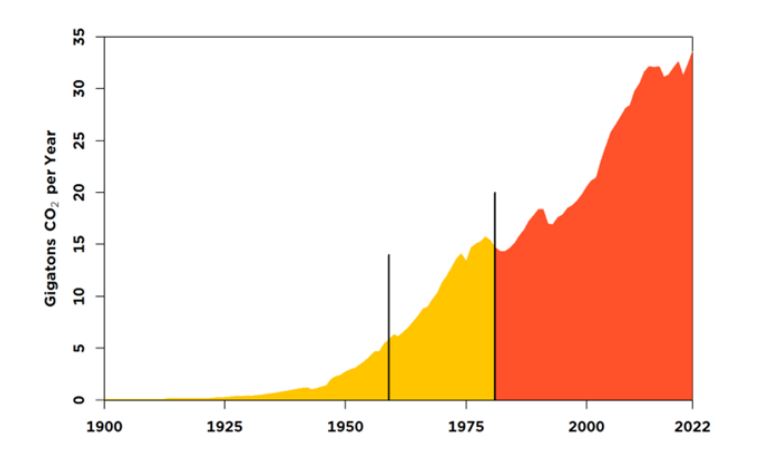
In 1959, renowned nuclear physicist (and Manhattan Project scientist) Edward Teller keynoted an event in New York City organized by the American Petroleum Institute (API), the nation’s largest oil industry trade association. In his address, Teller discussed the problem of rising levels of carbon dioxide in the atmosphere caused by the burning of fossil fuels and warned the audience of high-level oil industry executives that “a temperature rise corresponding to a 10 [percent] increase in carbon dioxide will be sufficient to melt the icecap and submerge . . . all the coastal cities [emphasis added].”
In February 1980, API hosted a meeting for industry leaders with Stanford climate scientist John Laurmann, who offered a technical discussion of global warming. Participants included representatives of Exxon and oil companies that are now subsidiaries of BP and Chevron, and notes from the meeting were distributed to all the major API member companies. Laurmann told the task force that there was “strong empirical evidence that [the carbon dioxide] rise [was] caused by anthropogenic release of CO2, mainly from fossil fuel burning.” Unless fossil fuel production and use were controlled, he said, the planet could expect an increase in global average temperature of 2.5°C by 2038 that would bring “major economic consequences,” as well as the prospect of a 5°C increase by 2067, with “globally catastrophic effects.” Laurmann warned that there was “no leeway” regarding the “time for action.”
In August 1981, Roger Cohen, then Exxon’s director of theoretical and mathematical sciences, wrote a brief memo reviewing the company’s emerging understanding of the severity of potential climate risks. In it, Cohen took issue with an internal corporate document that had described projected climate change impacts by 2030 as “of a magnitude well short of catastrophic.” Cohen called that assessment “too reassuring;” he told top company executives that it was “distinctly possible that the CPD [corporate planning department] scenario will likely produce effects which will indeed be catastrophic (at least for a substantial fraction of the earth’s population) [emphasis added].” According to 2019 congressional testimony by former Exxon staff scientist Martin Hoffert, during the 1980s he recognized that the company was deceiving the public and publicly promoting views that its own scientists knew were wrong.
Fossil Fuel Companies Developed—and Continue to Carry Out—Highly Deceptive Public Relations and Lobbying Campaigns to Stall Climate Action
An equally important part of the story is much more recent, revealing the fossil fuel industry’s campaign of deception, diversion, and delay that continues to this day. We’ve seen companies deploy many of the strategies and tactics laid out in the API’s infamous 1998 “Roadmap” memo (described in detail in The Climate Deception Dossiers) which stated that “Victory will be achieved when average citizens ‘understand’ (recognize) uncertainties in climate science”—a tactic of sowing doubt that borrowed heavily from the tobacco industry’s playbook.
In the report you’ll find:
- confessions by a former ExxonMobil lobbyist that the corporation used front groups to “aggressively fight against… the science”;
- a fossil fuel industry-funded website that attacks climate accountability experts while promoting false claims about oil, fossil gas, and environmental and economic issues;
- a fossil fuel industry lobbying effort that set up fake grassroots groups with misleading names to attack climate and clean energy policies;
- an oil and gas industry policy briefing book that targets corporate climate disclosure rules for elimination; and even
- court documents and related reporting suggesting that the US government possesses evidence that an alleged criminal scheme to hack into the email accounts of staff at UCS and other public interest organizations in an effort to thwart climate accountability litigation was indirectly paid for by ExxonMobil and that one of its lobbying firms, the Washington, DC-based DCI Group, provided a list of “targets” to a middleman linked to the hackers and sent the fruits of the hacking to the oil and gas company.
By expanding their oil and gas production and increasing global warming emissions, while deploying delays, diversionary tactics, and calculated disinformation, fossil fuel corporations have lost the public trust as good-faith actors. Like the tobacco industry, the fossil fuel industry deserves to have its immense power and social license curtailed. Fossil fuel corporations need to be held accountable for their actions and for the climate destruction they have contributed to. Their continued malfeasance is all the more dangerous at a time when the US federal government is backsliding on climate action.
A Call to Action: Pressure the Fossil Fuel Industry
UCS is ratcheting up our demands to the fossil fuel industry—calling for a massive increase in pressure on these corporations from affected communities, experts, consumers, public prosecutors, litigators, investors, financiers, business partners, regulators, and policymakers.
1. First and foremost, we demand that major fossil fuel corporations cease disinformation and greenwashing on climate science, public policy, and corporate actions.
Fossil fuel companies must end their greenwashing campaigns, their attempts to downplay the severity of the climate crisis, and their diversionary tactics that distract from the urgent need to phase out fossil fuels. They must admit and publicly renounce past wrongdoing and issue corrective statements similar to those required of the tobacco industry after a federal court ruled that major US tobacco corporations had violated civil racketeering laws and engaged in a decades-long conspiracy to deceive the public.
2. We also insist that major fossil fuel corporations stop obstructing science-informed public policy and its implementation.
Just as the tobacco industry has a fundamental and irreconcilable conflict of interest with public health policymaking, the fossil fuel industry has a fundamental and irreconcilable conflict of interest with the development and implementation of public policies intended to limit fossil fuel-driven climate change and accelerate the transition to clean renewable energy. We must force them to finally stop spending their shareholders’ money on anti-climate lobbying, front groups, and misleading public relations campaigns.
3. It is past time for fossil fuel corporations to pay an equitable share of the costs of climate damages; climate adaptation; and the environmental, social, and systemic impacts of fossil fuel products and production.
For too long, fossil fuel corporations have privatized the profits of oil, gas, and coal while socializing the massive costs they could have prevented society from incurring. All of us are living with the effects of extreme heat, stronger hurricanes, extreme flooding, more devastating wildfires, and other climate impacts. These mounting climate impacts take a huge toll on our lives, well-being, and our cultural heritage and they impose an enormous economic burden. Environmental racism compounds the harm for Black, Brown, and Indigenous communities in the United States and across the Global South.
UCS’s new report highlights how we must use levers including investment, litigation, public exposure, and policymaking to also compel fossil fuel corporations to:
4. Fully disclose, and regularly and publicly report on, risks and impacts to the climate, communities, and the economy;
5. Accelerate actions, investment, and business planning for a fair and fast phaseout of fossil fuels worldwide;
6. Stop violating civil rights, human rights, and the rights of Indigenous peoples.
The rollbacks and reversals at the federal level in the United States make these changes all the more urgent and shine a key spotlight on the legal cases moving toward courts across the country—as well as the court of public opinion. As I wrote recently, it is looking increasingly possible that the Trump administration and the Republican-led Congress may try to give the fossil fuel industry what it wants most of all: immunity from liability for the enormous damages these corporations have knowingly caused to people and the planet. Congress must resist such efforts and protect the ability of states, municipalities, and others harmed by fossil fuel-driven climate change to hold polluters accountable through litigation and legislation. The industry has gotten away with denial and deception for far too long. It’s time for all of us to make sure the major fossil fuel corporations are held to account.
Congress refusing to shield the fossil fuel industry from facing consequences for its deception and the massive resulting harm would be a signal that the message of Decades of Deceit has gotten through.
Please read the report and take action today. You can start by writing to your governor and state attorney general to let them know you support efforts to hold the fossil fuel industry accountable for its climate deception and the resulting damage to local communities.
from — Mulvey, K. (2025, May 14). Climate accountability: the antidote to decades of fossil fuel industry deceit. The Equation.
~ ~ ~
climate
climate, noun
-
the composite or generally prevailing weather conditions of a region, as temperature, air pressure, humidity, precipitation, sunshine, cloudiness, and winds, throughout the year, averaged over a series of years.
-
a region or area characterized by a given climate.
to move to a warm climate.
-
the prevailing attitudes, standards, or environmental conditions of a group, period, or place.
a climate of political unrest.
- Synonyms:
- temper, tone, spirit, atmosphere, mood
climate, scientific
The general or average weather conditions of a certain region, including temperature, rainfall, and wind. On Earth, climate is most affected by latitude, the tilt of the Earth’s axis, the movements of the Earth’s wind belts, the difference in temperatures of land and sea, and topography. Human activity, especially relating to actions relating to the depletion of the ozone layer, is also an important factor.
climate, cultural
A region’s usual weather patterns. The climate at any point on Earth is determined by things such as the general movement of the atmosphere, the proximity of the oceans, and the altitude of the location.
Usage
Climatic is sometimes wrongly used where climactic is meant. Climatic is properly used to talk about things relating to climate; climactic is used to describe something which forms a climax
Discover More
The climate also is affected by the sun, by changes in the orbit of the Earth, by plate tectonics, and by human activities, particularly the burning of fossil fuels, which may lead to a greenhouse effect.
Other Word Forms
- climatic adjective
- climatically adverb
- subclimate noun
Etymology
Origin of climate
First recorded in 1350–1400, for an earlier sense; 1595–1605 climate for def. 2; Middle English climat, from Latin clīmat- (stem of clīma ), from Greek klīmat- , stem of klī́ma “slope,” from klī́(nein) “to bend, lean, slope” + -ma, noun suffix
from — Definition of climate. (n.d.).
~ ~ ~
accountability
accountability, noun
-
the state of being accountable, liable, or answerable.
-
Education. a policy of holding schools and teachers accountable for students’ academic progress by linking such progress with funding for salaries, maintenance, etc.
Usage
What does accountability mean? Accountability is the obligation to explain, justify, and take responsibility for one’s actions. Accountability is the state of being accountable, meaning responsible for something or obligated to answer to someone, such as a person with more authority, like a boss. The word accountability is often used in the context of individuals, especially in the term personal accountability. It is also commonly used in the context of institutions or people that are responsible to the public, such as the government, its agencies, politicians, and the media. Accountability is often discussed with transparency and consequences. This typically involves keeping people and organizations accountable by making their actions visible and having consequences when those actions are not acceptable. Example: The system of checks and balances is intended to ensure accountability among the different branches of government.
Other Word Forms
- nonaccountability noun
Etymology
Origin of accountability
First recorded in 1785–95; account(able) + -ability
Related Words
January 19th, 2026
Hudson Valley, New York
This is one of the words/ phrases you can’t say in the new Trump Regime. See a comprehensive list at the Forbidden Words Project.
image: 22-B © Holly Troy 2026
These policies’ tentacles already extend beyond government websites, though removing HIV resources from the Centers for Disease Control and Prevention, regardless of whether they mentioned “gender ideology” or other banned terms, is bad enough. Reports say scientists are self-censoring in hopes of improving their chances of getting government grants.
from — Connelly, E. A. (2025, December 22). Federal Government’s Growing Banned Words List Is Chilling Act of Censorship. PEN America.
Discover more from holly troy ~ sacred folly
Subscribe to get the latest posts sent to your email.
 holly troy ~ sacred folly
The climate impact / of nations, corporations / must be accounted
LikeLike