forbidden words: changing climate
changing climate
Climate change refers to the long-term changes in the Earth’s climate that are warming the atmosphere, ocean and land. Climate change is affecting the balance of ecosystems that support life and biodiversity, and impacting health. It also causes more extreme weather events, such as more frequent and more intense hurricanes, floods, heatwaves and droughts, and leads to sea level rise and coastal erosion as a result of ocean warming, melting of glaciers and loss of ice sheets.
from — The Climate Dictionary: An everyday guide to climate change. (2024, October 2). UNDP Climate Promise.
United Nations: What Is Climate Change?
Climate change refers to long-term shifts in temperatures and weather patterns. Such shifts can be natural, due to changes in the sun’s activity or large volcanic eruptions. But since the 1800s, human activities have been the main driver of climate change, primarily due to the burning of fossil fuels like coal, oil and gas.
Burning fossil fuels generates greenhouse gas emissions that act like a blanket wrapped around the Earth, trapping the sun’s heat and raising temperatures.
The main greenhouse gases that are causing climate change include carbon dioxide and methane. These come from using gasoline for driving a car or coal for heating a building, for example. Clearing land and cutting down forests can also release carbon dioxide. Agriculture, oil and gas operations are major sources of methane emissions. Energy, industry, transport, buildings, agriculture and land use are among the main sectors causing greenhouse gases.
Humans are responsible for global warming
Climate scientists have showed that humans are responsible for virtually all global heating over the last 200 years. Human activities like the ones mentioned above are causing greenhouse gases that are warming the world faster than at any time in at least the last two thousand years.
The average temperature of the Earth’s surface is now about 1.42°C warmer than it was in the late 1800s-prior to the industrial revolution-and warmer than at any time in the last 100,000 years. The last decade (2015-2024) was the warmest on record, and each of the last four decades has been warmer than any previous decade since 1850.
Many people think that climate change mainly means warmer temperatures. But temperature rise is only the beginning of the story. Because the Earth is a system where everything is connected, changes in one area can influence changes in all others.
The consequences of climate change include, among others, intense droughts, water scarcity, severe fires, rising sea levels, flooding, melting polar ice, catastrophic storms and declining biodiversity.
People are experiencing climate change in diverse ways
Climate change can affect our health, ability to grow food, housing, safety and work. Some of us are already more vulnerable to climate impacts, such as people living in small island nations and other developing countries. Conditions like sea-level rise and saltwater intrusion have advanced to the point where entire communities have had to relocate, while protracted droughts are putting people at risk of famine. In the future, the number of people displaced by weather-related events is expected to rise.
Every increase in global warming matters
In a series of UN reports, thousands of scientists and government reviewers agreed that limiting global temperature rise to no more than 1.5°C would help us avoid the worst climate impacts and maintain a liveable climate. Yet policies currently in place point to up to 2.8°C of warming by the end of the century.
The emissions that cause climate change come from every part of the world and affect everyone, but some countries produce much more than others. The six biggest emitters (China, the United States of America, India, the European Union, the Russian Federation, and Indonesia) together account for more than half of all global greenhouse gas emissions. By contrast, the 45 least developed countries contribute only 3 per cent of global greenhouse gas emissions.
Everyone must take climate action, but people and countries creating more of the problem have a greater responsibility to act first.
We face a huge challenge but already know many solutions
Many climate change solutions can deliver economic benefits while improving our lives and protecting the environment. We also have global frameworks and agreements to guide progress, such as the Sustainable Development Goals, the UN Framework Convention on Climate Change and the Paris Agreement. Three broad categories of action are: cutting emissions, adapting to climate impacts and financing required adjustments.
Switching energy systems from fossil fuels to renewables like solar or wind will reduce the emissions driving climate change. But we have to act now. While a growing number of countries is committing to net zero emissions by 2050, emissions must be cut in half by 2030 to keep warming below 1.5°C. Achieving this means huge declines in the use of coal, oil and gas: production and consumption of all fossil fuels need to be cut by at least 30 per cent by 2030 in order to prevent catastrophic levels of climate change.
Adapting to climate consequences protects people, homes, businesses, livelihoods, infrastructure and natural ecosystems. It covers current impacts and those likely in the future. Adaptation will be required everywhere but must be prioritized now for the most vulnerable people with the fewest resources to cope with climate hazards. The rate of return can be high. Early warning systems for disasters, for instance, save lives and property, and can deliver benefits up to 10 times the initial cost.
We can pay the bill now, or pay dearly in the future
Climate action requires significant financial investments by governments and businesses. But climate inaction is vastly more expensive. One critical step is for developed countries to support developing countries so they can adapt and move towards greener economies.
from — United Nations. (n.d.). What is climate change? | United Nations.
~ ~ ~
changing
changing, verb, used with object
changed, changing
-
to make the form, nature, content, future course, etc., of (something) different from what it is or from what it would be if left alone.
to change one’s name;
to change one’s opinion;
to change the course of history.
-
to transform or convert (usually followed byinto ).
The witch changed the prince into a toad.
-
to substitute another or others for; exchange for something else, usually of the same kind.
She changed her shoes when she got home from the office.
-
to give and take reciprocally; interchange.
to change places with someone.
- Synonyms:
- trade
-
to transfer from one (conveyance) to another.
You’ll have to change planes in Chicago.
-
to give or get an equivalent amount of money in lower denominations in exchange for.
to change a five-dollar bill.
-
to give or get foreign money in exchange for.
to change dollars into euros.
- Synonyms:
- convert
-
to remove and replace the covering or coverings of.
to change a bed.
-
to remove a dirty diaper from (a baby) and replace it with a clean one.
new parents, learning to change a baby.
changing, verb, used without object
changed, changing
-
to become different.
Overnight the nation’s mood changed.
-
to become altered or modified.
Colors change if they are exposed to the sun.
- Antonyms:
- remain
-
to become transformed or converted (usually followed byinto ).
The toad changed back into a prince.
-
to pass gradually into (usually followed by to orinto ).
Summer changed to autumn.
-
to switch or to make an exchange.
If you want to sit next to the window, I’ll change with you.
-
to transfer between trains or other conveyances.
We can take the local and change to an express at the next stop.
-
to remove one’s clothes and put on different clothes.
She changed into jeans.
-
(of the moon) to pass from one phase to another.
-
(of the voice) to become deeper in tone; come to have a lower register.
The boy’s voice began to change when he was thirteen.
change, noun
-
the act or fact of changing; fact of being changed.
They are pleased by the change in their son’s behavior.
- Synonyms:
- vicissitude, conversion, mutation, transmutation, transmutation
- Antonyms:
- permanence
-
a transformation or modification; alteration.
They noticed the change in his facial expression.
-
a variation or deviation.
a change in the daily routine.
-
the substitution of one thing for another.
We finally made the change to an oil-burning furnace.
- Synonyms:
- exchange
-
variety or novelty.
Let’s try a new restaurant for a change.
-
the passing from one place, state, form, or phase to another.
a change of seasons;
social change.
-
Jazz. harmonic progression from one tonality to another; modulation.
-
the supplanting of one thing by another.
We need a total change of leadership.
- Synonyms:
- replacement, replacement
-
anything that is or may be substituted for another.
- Synonyms:
- replacement, replacement
-
a fresh set of clothing.
-
money given in exchange for an equivalent of higher denomination.
-
a balance of money that is returned when the sum tendered in payment is larger than the sum due.
-
coins of low denomination.
-
any of the various sequences in which a peal of bells may be rung.
-
British. Also ‘change exchange.
-
Obsolete. changefulness; caprice.
change, verb phrase
idioms
-
change one’s mind, to change one’s opinions or intentions.
-
change hands. hand.
-
ring the changes,
-
to perform all permutations possible in ringing a set of tuned bells, as in a bell tower of a church.
-
to vary the manner of performing an action or of discussing a subject; repeat with variations.
-
-
change front, to shift a military force in another direction.
Other Word Forms
- changedness noun
- changeless adjective
- changelessly adverb
- changelessness noun
- changer noun
- unchanged adjective
- unchanging adjective
- unchangingly adverb
- unchangingness noun
Etymology
Origin of change
First recorded in 1175–1225; Middle English verb cha(u)ngen, from Anglo-French, Old French changer, from Late Latin cambiāre, Latin cambīre “to exchange, barter”; Middle English noun cha(u)nge, from Anglo-French, Old French, noun derivative of the verb; of Celtic origin
from —
Definition of change. (n.d.).
~ ~ ~
climate
climate, noun
-
the composite or generally prevailing weather conditions of a region, as temperature, air pressure, humidity, precipitation, sunshine, cloudiness, and winds, throughout the year, averaged over a series of years.
-
a region or area characterized by a given climate.
to move to a warm climate.
-
the prevailing attitudes, standards, or environmental conditions of a group, period, or place.
a climate of political unrest.
- Synonyms:
- temper, tone, spirit, atmosphere, mood
climate, scientific
The general or average weather conditions of a certain region, including temperature, rainfall, and wind. On Earth, climate is most affected by latitude, the tilt of the Earth’s axis, the movements of the Earth’s wind belts, the difference in temperatures of land and sea, and topography. Human activity, especially relating to actions relating to the depletion of the ozone layer, is also an important factor.
climate, cultural
A region’s usual weather patterns. The climate at any point on Earth is determined by things such as the general movement of the atmosphere, the proximity of the oceans, and the altitude of the location.
Usage
Climatic is sometimes wrongly used where climactic is meant. Climatic is properly used to talk about things relating to climate; climactic is used to describe something which forms a climax
Discover More
The climate also is affected by the sun, by changes in the orbit of the Earth, by plate tectonics, and by human activities, particularly the burning of fossil fuels, which may lead to a greenhouse effect.
Other Word Forms
- climatic adjective
- climatically adverb
- subclimate noun
Etymology
Origin of climate
First recorded in 1350–1400, for an earlier sense; 1595–1605 climate for def. 2; Middle English climat, from Latin clīmat- (stem of clīma ), from Greek klīmat- , stem of klī́ma “slope,” from klī́(nein) “to bend, lean, slope” + -ma, noun suffix
from — Definition of climate. (n.d.).
January 10th, 2025
Hudson Valley, New York
This is one of the words/ phrases you can’t say in the new Trump Regime. See a comprehensive list at the Forbidden Words Project.
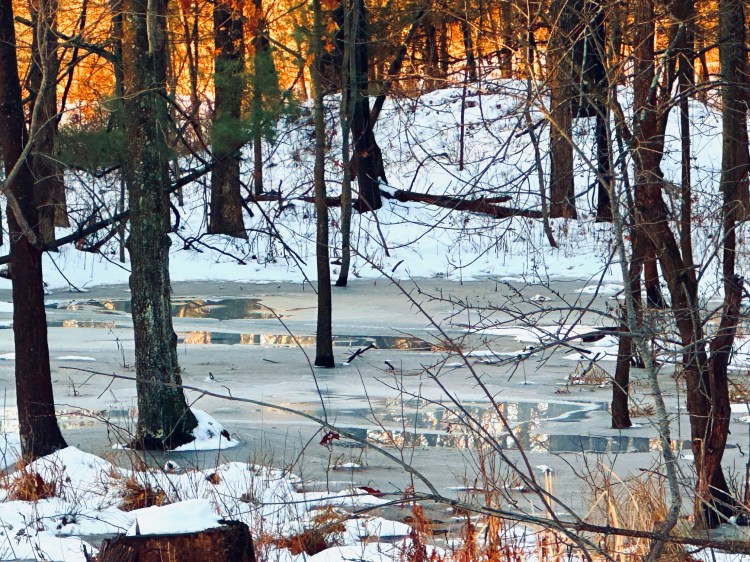
image: wetlands melt © Holly Troy 2025
Some of these moves seem tragically comical, like the elimination of photos from a Defense Department database of the World War II B-29 aircraft Enola Gay while erasing the recognition of the service of LGBTQ+ Americans who served in the military. But this is not just the ham-handed applications of President Trump’s executive orders. The reckless manner in which this is being done without regard to the consequences illustrates its nefarious intent.
from — Connelly, E. A. (2025, December 22). Federal Government’s Growing Banned Words List Is Chilling Act of Censorship. PEN America.
Discover more from holly troy ~ sacred folly
Subscribe to get the latest posts sent to your email.
 holly troy ~ sacred folly
The impact we have / upon our changing climate / must be considered
LikeLiked by 1 person